A compact step unit designed to work with Active Birth Pools’ extra-wide rim, supporting safer entry and exit while helping reduce manual handling, trip and obstruction risks.
Safe entry and exit should be designed into the pool
Entering and leaving a water birth pool is one of the most important safety moments in water birth practice. A mother in strong lhttps://activebirthpools.com/wp-admin/edit.php?post_type=gltf_sceneabour may be tired, focused inward, experiencing contractions, less steady on her feet or moving instinctively rather than following a precise sequence of instructions.
For this reason, safe access should not depend on climbing, balancing at height, stepping over a high rim or relying heavily on a midwife or birth partner for physical support. It should be simple, grounded and intuitive.
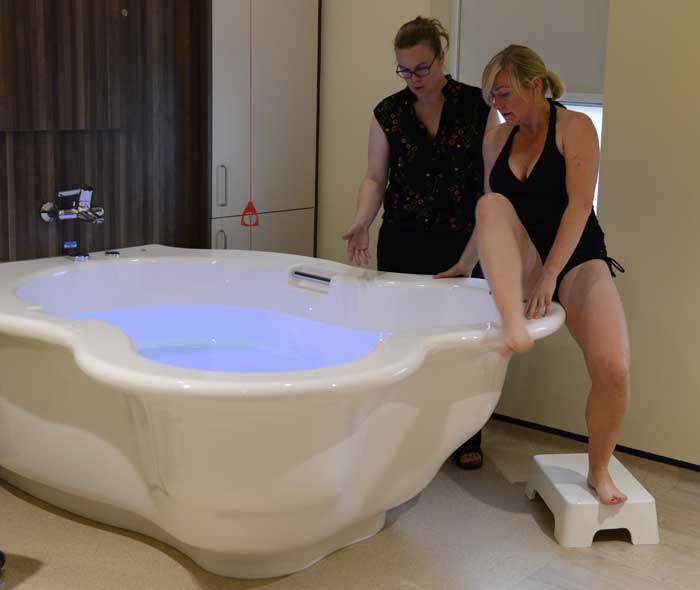
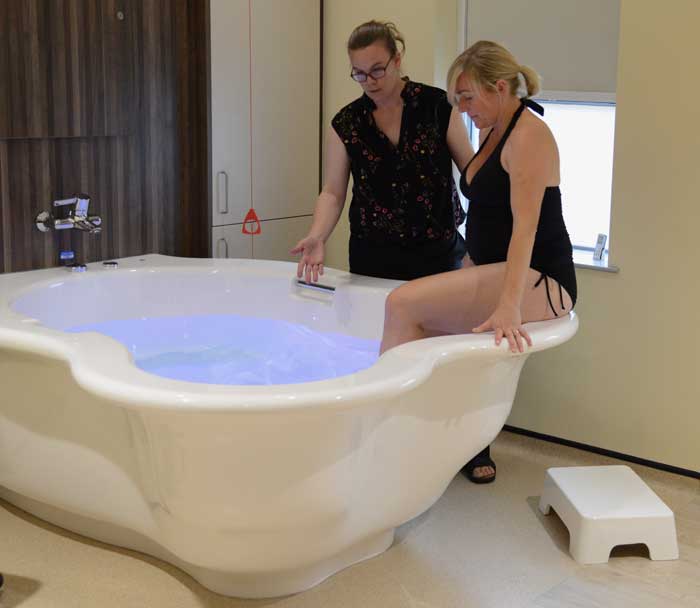
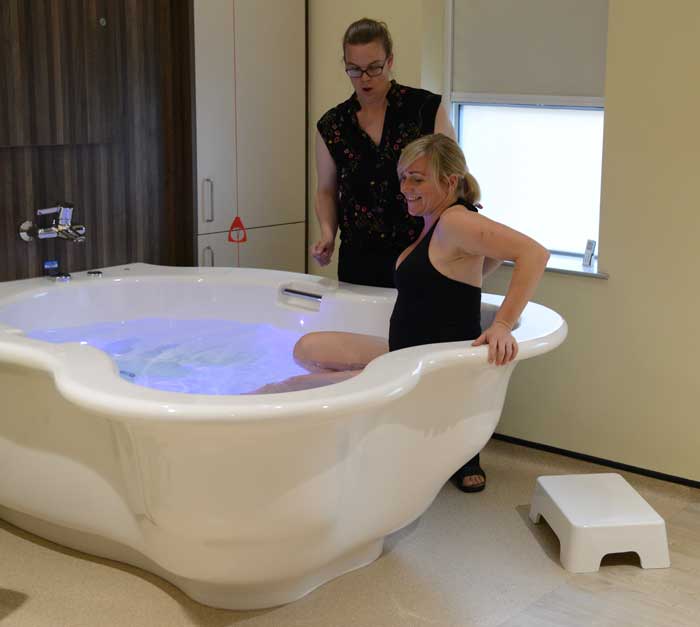
The Active Birth Pools Single Step Unit has been designed for this purpose. Used with the extra-wide, rounded rim of an Active Birth Pool, it enables the mother to step up, sit securely on the rim, swivel her legs into the pool and lower herself naturally into the water. [1,2,3]

The sit-and-swivel principle
The Single Step Unit is not a staircase. Its purpose is to reduce the effective entry height of the pool so the mother can sit on the rim before moving her legs over the edge.
Active Birth Pools are approximately 75 cm high. The Single Step Unit is approximately 15 cm high, reducing the effective entry height to about 60 cm — similar to the height of an ordinary bath. The mother steps onto the Single Step Unit, turns, sits on the wide bull-nosed rim, swivels one leg and then the other into the pool, and lowers herself into the water. [1,2]
This movement is familiar, controlled and stable. It allows the mother to pause while seated if a contraction comes. It also allows her to maintain useful points of contact with the rim, the step and supporting surfaces during the transfer. [2,3]
Why the wide rim matters
The Single Step Unit works because it is part of a complete access system. It is designed to be used with Active Birth Pools’ extra-wide rim, which varies between approximately 15 and 20 cm and has a large rounded bull-nose edge. This gives the mother a broad, comfortable support surface on which to sit and swivel. [1]
A narrow rim cannot provide the same access method. If a pool rim is too narrow, sharp or uncomfortable to sit on, the mother may be forced to climb, balance, step across the rim and descend into the pool while standing. This is why some pool designs rely on bulky multi-step units and handrails. These accessories may look reassuring, but they do not remove the underlying hazards created by climbing in a wet clinical environment. [3]
Active Birth Pools address the problem at design level. The Single Step Unit provides the height advantage; the wide rim provides the seated transfer surface; and the mother enters the pool through a natural step, sit, swivel and lower sequence.
Manual handling and health and safety
Manual handling risk in a birth pool room is not limited to dramatic emergency evacuations. It can occur during ordinary entry and exit, during close support, while staff work beside the pool, and whenever a mother becomes unsteady and uses a midwife as a support point.
HSE guidance on manual handling requires employers to avoid hazardous manual handling where reasonably practicable, assess unavoidable manual handling risk, and reduce the risk as far as reasonably practicable. [4,5]
HSE guidance specific to birthing pools identifies risks arising from the position of the mother, the position of the midwife, active support during entry and exit, pool design, the surrounding environment, equipment, emergency evacuation, cleaning and other associated tasks. It also states that the pool design should allow the midwife to get as close as possible to the mother and minimise bending and reaching over. [6]
The Single Step Unit supports these principles because it helps avoid a higher-risk movement sequence. Instead of asking a mother to climb up steps, stand at height, step over the rim and descend into water, it helps her become seated before moving her legs into the pool. This reduces the likelihood that the midwife will become the mother’s main physical support point. [2,3]
Reducing trip and obstruction risks
A water birth room is a wet clinical environment. Water may be present around the access point. Staff, partners and equipment may need to move around the pool. In an urgent situation, clear access can matter.
Bulky multi-step units can introduce avoidable risks. If they are left beside the pool, they may obstruct the area where midwives need to stand, kneel, turn, observe and assist. If they are moved away, they create another handling, cleaning, drying and storage task. Either way, they can add complexity to the room. [2,3]
The Active Birth Pools Single Step Unit is compact and simple. It provides the height advantage required for entry and exit without dominating the poolside. When not in use for entry or exit, it is easier to move, clean, dry and store than a large multi-step access system. [1,3]
Stable, sturdy and designed for wet-room use
The Single Step Unit is fabricated from Vitrite® composite and has a patterned surface designed to improve grip under practical use conditions. [1]
It is important not to describe any wet surface as slip-proof. In a birth pool room, safe practice still depends on good housekeeping, appropriate flooring, staff guidance, correct positioning of the step and careful support during entry and exit. However, the Single Step Unit is designed for the realities of wet-room maternity use and forms part of a wider access strategy intended to reduce slips, trips, falls and manual handling exposure. [1,3,7]
It also works with the Ficore® surface of Active Birth Pools. Ficore® has a greater adhesive factor than fibreglass or acrylic and is less slippery / more slip resistant than those materials. This does not mean Ficore® is slip-proof, but it does provide a more secure-feeling surface for mothers using the rim, sides and support areas during labour and movement. [8]
Why a single step is safer than a multi-step approach
The safest access strategy is not necessarily the one with the most equipment. In many cases, safer design means removing unnecessary movements.
A multi-step system may require the mother to climb, turn, balance, step over the pool rim, descend into the water and find a submerged landing surface. Each stage introduces a potential point of instability. If a contraction occurs halfway through the movement, the risk increases further. [3]
By contrast, the Single Step Unit supports a lower, simpler and more controlled transfer. The mother steps up once, sits down, swivels and lowers into the pool. If she needs to pause, she can pause while seated rather than while standing on a raised step unit. [2,3]
This protects the mother, but it also protects the midwife. The midwife remains close enough to guide and reassure, but is less likely to be pulled, twisted or suddenly loaded as the mother tries to steady herself. [3,6]
Emergency access
Emergency evacuation from a birth pool is uncommon, but it must be planned for. HSE guidance states that appropriate procedures should be in place, including how to get the mother out of the pool, how many staff or helpers are required, how to call for additional help, and what equipment may be needed. [6]
The Single Step Unit supports this planning by helping keep the poolside clearer than a bulky multi-step unit. It does not require a large handrail structure beside the pool and does not permanently occupy the working edge. Clear access around the pool helps staff move, position equipment and respond quickly if circumstances change. [3,6]
Procurement questions for maternity teams

Conclusion
The Active Birth Pools Single Step Unit is a simple but important safety feature. Its value lies not in creating a staircase, but in avoiding the need for one.
Used with the extra-wide bull-nosed rim of an Active Birth Pool, it supports a grounded sit-and-swivel method that is easier for the mother, less demanding for the midwife and better suited to the wet clinical realities of a water birth room.
It helps reduce climbing, awkward stepping, over-assistance, obstruction and trip risk. It also provides a practical kneeling support for midwives once the mother is in the water.
For hospitals, birth centres, architects and maternity teams, the principle is clear: safer access should be designed into the pool from the outset. The Active Birth Pools Single Step Unit does exactly that.
Step Unit Specifications
Length: 455mm
Width: 300mm
Height: 150mm
Weight: 4kg
Material: Vitrine® composite
Guarantee: 2 years
References
[1] Active Birth Pools. “Guidance for women on how to get into and out of a water birth pool.” Active Birth Pools PDF, 2015.
[2] Active Birth Pools. “Sit and Swivel – the Safe Way to Enter a Water Birth Pool.” Active Birth Pools, 2026.
[3] Active Birth Pools. “Manual Handling Assessment: Safe Entry and Exit for Hospital Water Birth Pools.” Active Birth Pools, 2026.
[4] Health and Safety Executive. “Manual handling at work.” HSE guidance, updated 25 March 2024.
[5] Health and Safety Executive. “Manual handling at work: Reduce the risk of injury.” HSE guidance, updated 1 April 2025.
[6] Health and Safety Executive. “Moving and handling in health and social care: Manual handling in birthing pools.” HSE guidance, updated 12 January 2026.
[7] Health and Safety Executive. “Preventing slips and trips at work: A brief guide.” INDG225(rev2), HSE.
[8] Active Birth Pools. “Superior Material Results in Superior Safety, Value and Performance” and Active Birth Pools Catalogue material on Ficore® composite.