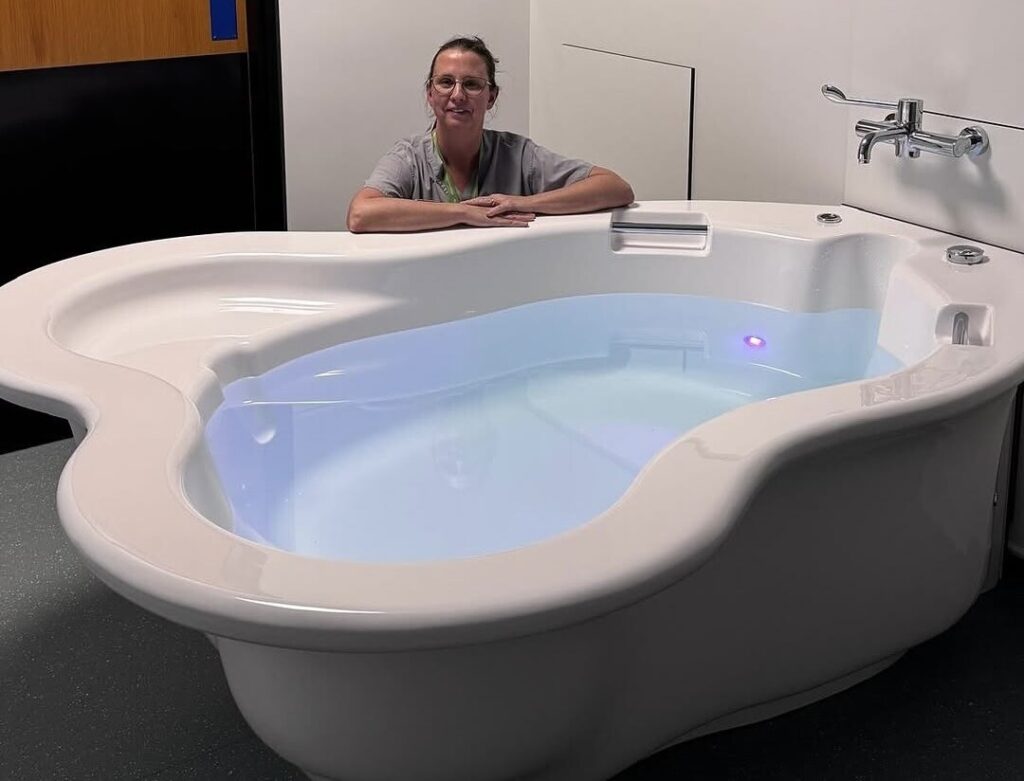

Why choice of material determines safety, usability, hygiene and over-all whole-life value
A bath is a simple object. It holds water. It needs to be comfortable, durable and easy to clean.
A water birth pool is also a simple object in principle.
But in a hospital maternity unit, that simplicity is deceptive.
A hospital water birth pool must cope with repeated filling and emptying, frequent cleaning and disinfection, temperature change, the weight of water and mother, and the everyday demands of a busy clinical environment.
In maternity settings, the pool is part of the care environment rather than a domestic bathroom product.
NICE guidance recognises birth in water as an option to consider and discuss with women and pregnant people, which makes the design and maintainability of the pool itself important to safe service provision. [1]
So when hospitals compare water birth pools, the most important question is not: “What does it look like?” It is: “What material is it made from?”
Because the material determines almost everything that matters: strength, hygiene, durability, comfort, wet-use performance, expected service life, sustainability and long-term value.

Simple products expose material quality
Complex products can sometimes hide mediocre materials behind technology and features. A water birth pool cannot.
Its performance depends directly on the integrity of its structure and surface. The material has to create a pool that is rigid, stable, smooth, non-porous, easy to clean and able to withstand years of professional use.
Those qualities cannot be added later. They have to be built into the product from the start.
A lower-cost pool may look perfectly acceptable when it is new. Most products do. The real test comes later.
How does the surface perform after years of use? How does it respond to repeated cleaning and disinfection? Does it remain rigid? Does it scratch, chip, stain or deteriorate? Can it be repaired? How soon will it need to be replaced?
That is where material quality reveals itself.
The surface is not cosmetic
In a hospital, the surface of a water birth pool is not just part of its appearance.
It is the part that comes into contact with the water, the mother and the hospital’s cleaning procedures. It must remain smooth, intact, accessible and inspectable for effective cleaning.
Healthcare building guidance repeatedly emphasises surfaces and sanitary assemblies that can be cleaned, maintained and used safely in clinical environments.
HBN 00-10 Part C deals specifically with sanitary assemblies, while HBN 00-02 provides design guidance for sanitary spaces in healthcare buildings. [2,3]
Damage matters.
Scratches, chips, cracks, joints and surface-mounted fittings can create areas that are harder to inspect and clean.
A pool may still look serviceable from a distance while its surface is becoming more difficult to maintain.
This is why hospitals should consider material quality and construction quality together.
A strong structure with a poor surface is not enough.
Nor is an attractive finish enough if the pool lacks rigidity or durability.
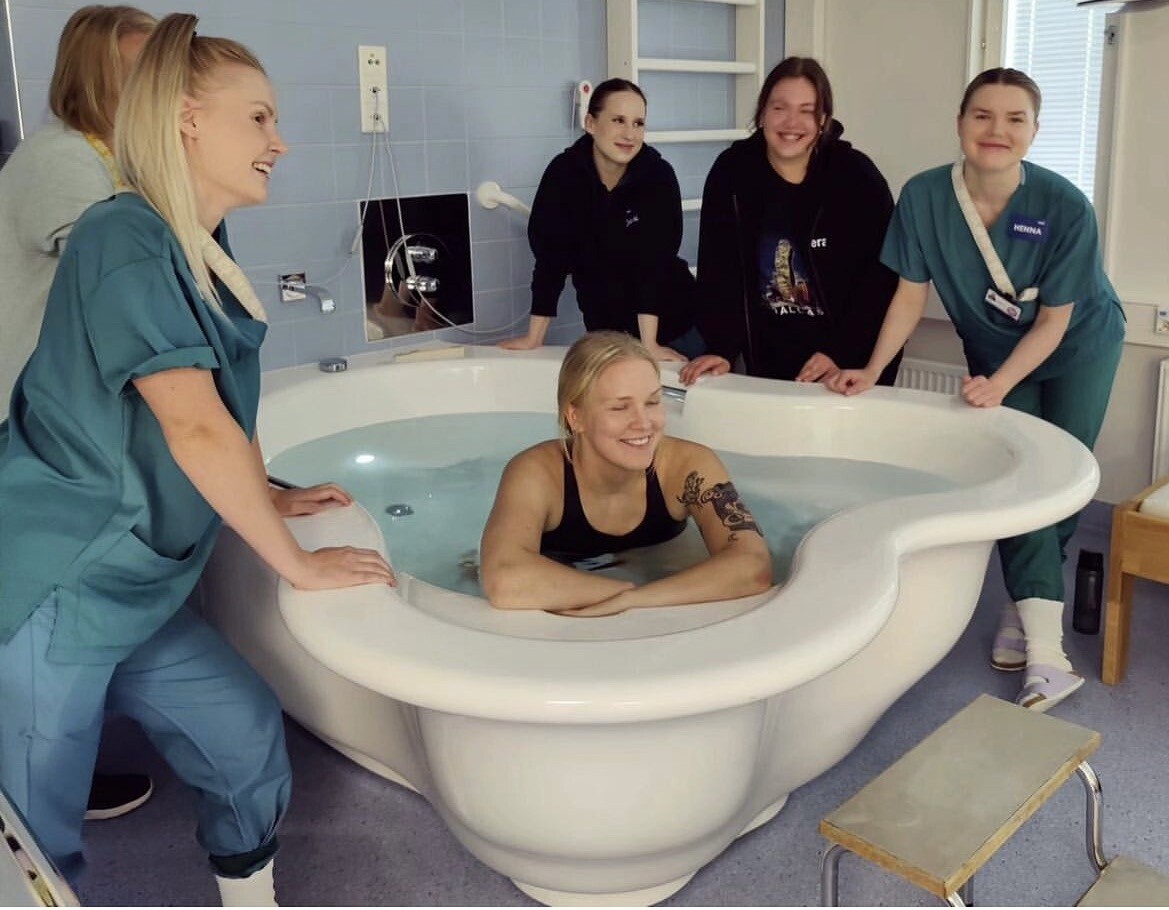
Seamless construction makes sense
Every unnecessary seam, joint, projection and attached fitting adds complexity.
Complexity means more edges to clean, more potential weak points and more places where water or contamination may collect.
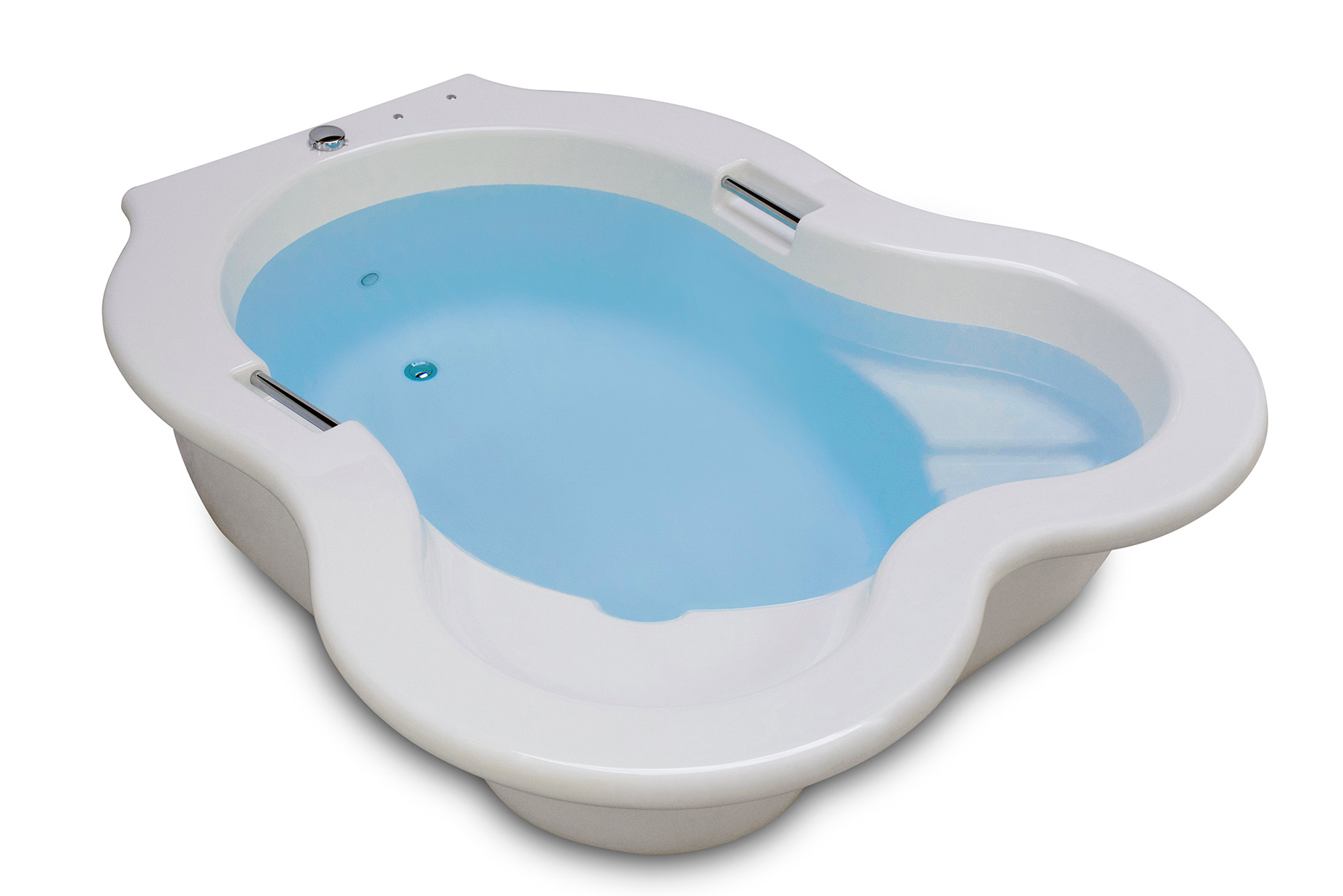
A seamless, one-piece pool is simpler to inspect, simpler to maintain and easier to clean consistently.
It also allows handgrips, support areas and rounded rims to be formed into the pool itself rather than added afterwards.
This matters because simplicity, when it is properly engineered, is not merely an aesthetic quality.
It is a practical advantage.
The same principle is reflected in infection-control design guidance: smooth, cleanable and impervious surfaces are preferred in clinical areas, and surfaces should be accessible and resistant to the effects of cleaning agents. [4]
Ficore®, fibreglass and acrylic
Fibreglass
Fibreglass pools are generally made by applying layers of glass-fibre reinforcement and resin into a mould. The visible surface is usually a gelcoat.
This method can produce complex shapes relatively economically. However, the performance of the pool depends heavily on the quality of both the laminate and the gelcoat.
Over time, gelcoat surfaces can become scratched, chipped, stained or worn. If damage exposes the underlying structure, cleaning can become more difficult and specialist repair may be required.
Fibreglass may offer a lower initial price, but hospitals should look carefully at surface durability, structural consistency and long-term performance.
Acrylic
Acrylic is widely used for domestic baths. It is usually made by heating and vacuum-forming a sheet of acrylic, then reinforcing it from underneath.
Acrylic can provide a smooth and attractive finish. However, the forming process can stretch and thin the material, particularly around deeper curves and more complex shapes.
The strength of the finished product therefore depends not only on the acrylic surface but also on the quality of the reinforcement behind it.
Acrylic can also be susceptible to scratching and may be affected by inappropriate cleaning products or abrasive methods. For domestic use, that may be acceptable. For repeated hospital use, it deserves closer scrutiny.
Ficore® Composite Resin
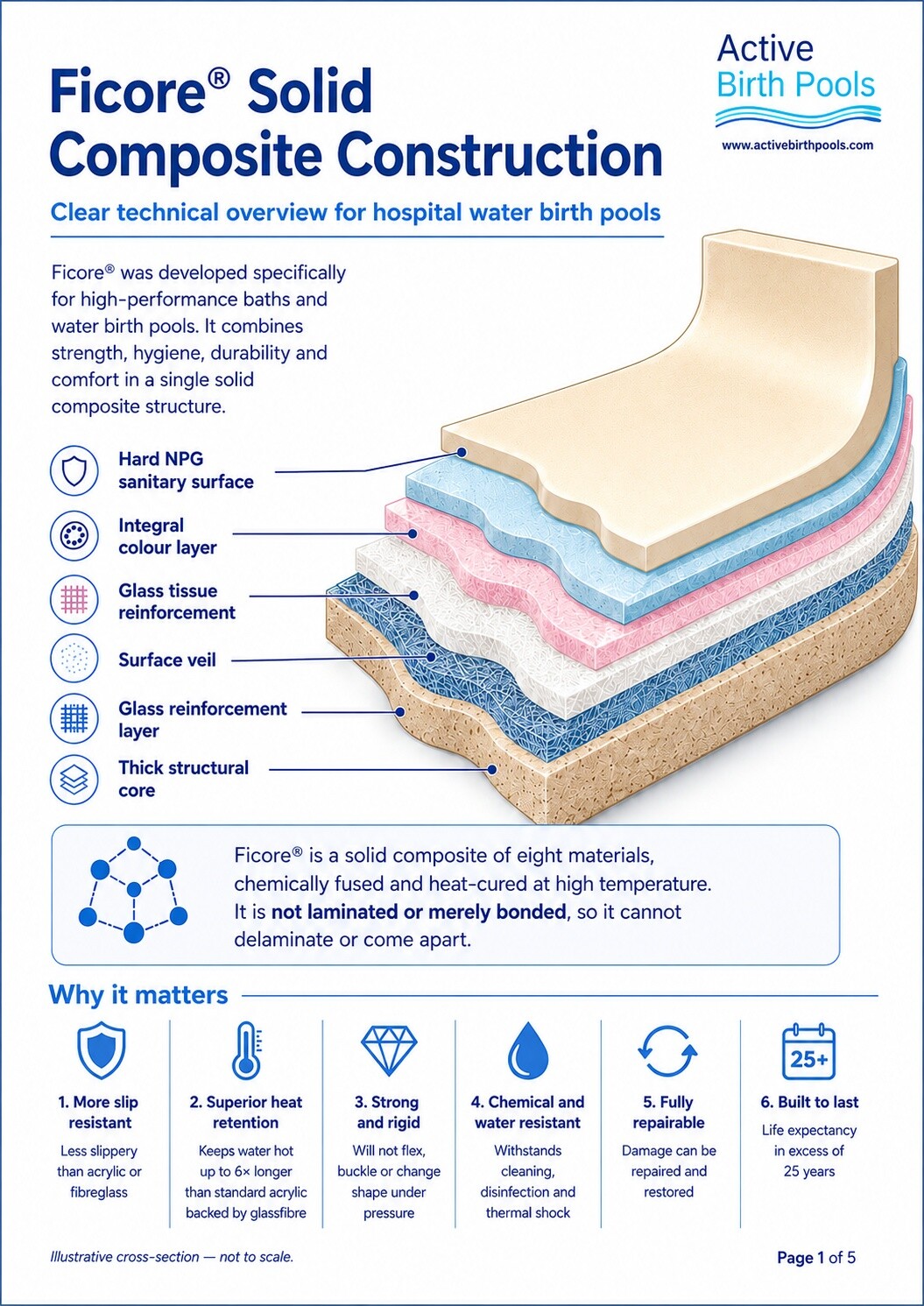
Ficore® is the specialist composite material used to manufacture Active Birth Pools.
Unlike acrylic, it is not a thin vacuum-formed sheet supported by a separate backing structure. Unlike conventional fibreglass, it does not rely on a thin decorative gelcoat over a laminate.
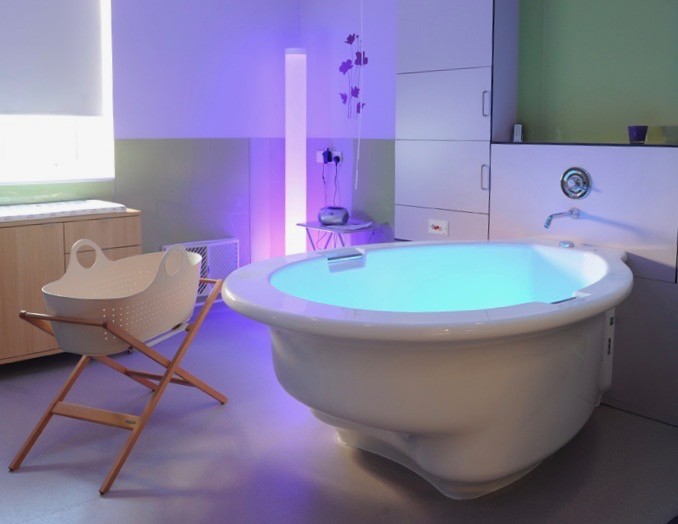
Ficore® is used to create a substantial, rigid, one-piece structure with a hard, smooth and non-porous surface. Active Birth Pools’ own Ficore® material specification describes it as a composite that is chemically fused and heat cured, rather than laminated or bonded. [12]
It is designed for repeated professional use in maternity environments where the pool must be filled, emptied, cleaned and disinfected again and again over many years.
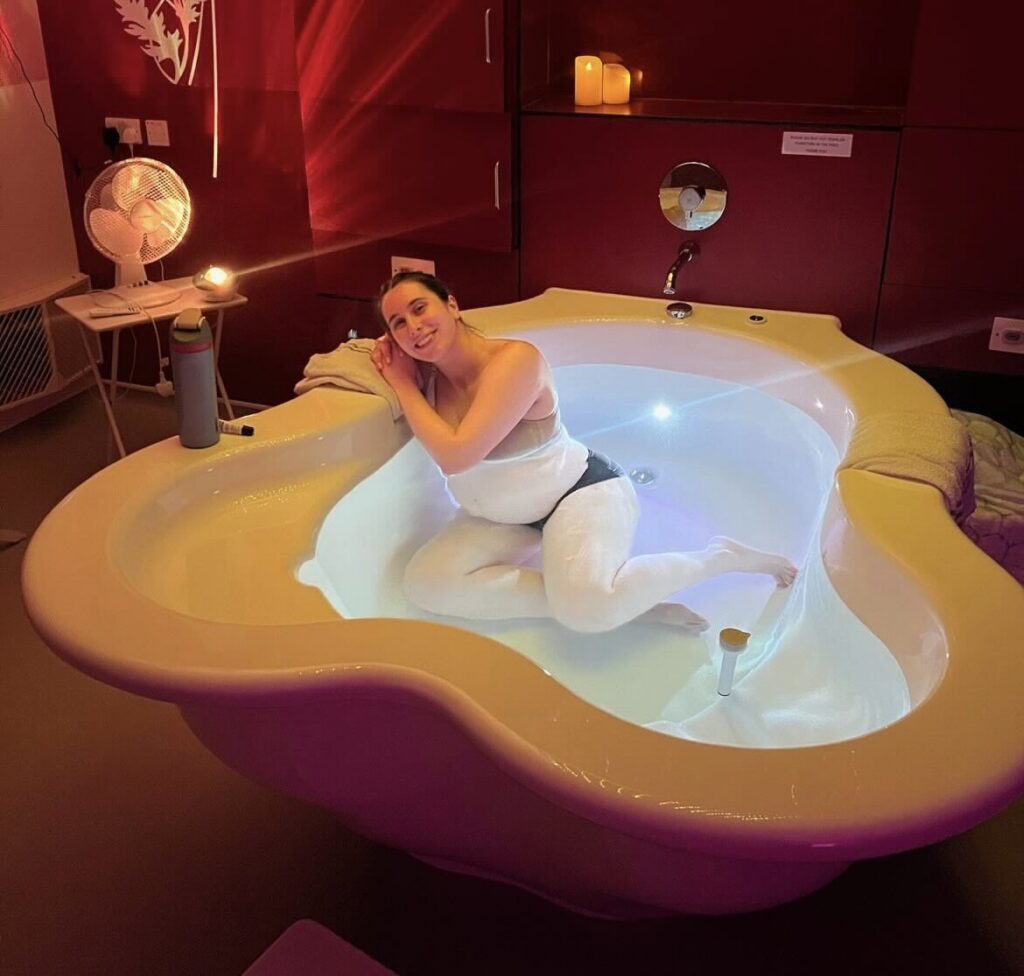
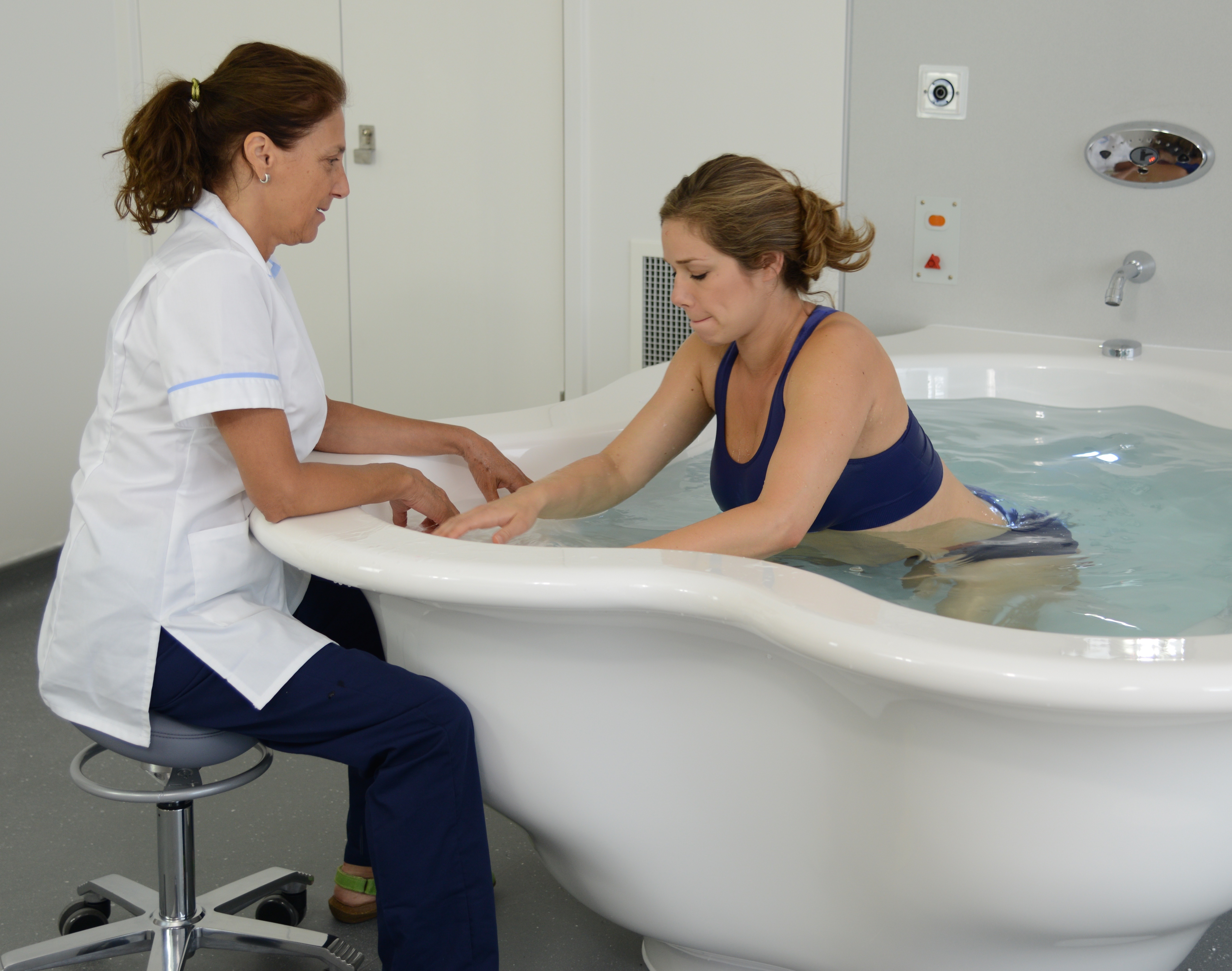
It also enables important ergonomic features to be moulded directly into the pool, including handgrips, support areas and broad rounded rims. This produces a cleaner, stronger and more integrated design. [8,10]
Less slippery, more tactile and warm to the touch
Ficore® has a greater adhesive factor than fibreglass or acrylic. In practical terms, its surface is less slippery than fibreglass or acrylic and more slip resistant than those materials.
That does not mean Ficore® should be described as slip-proof. No wet surface should be. It does mean that Ficore® offers a more secure-feeling surface for mothers who need to move instinctively and change position during labour.
Ficore® also has a warmer and more tactile feel than fibreglass or acrylic.
Because a mother in labour is in close, continuous contact with the pool — leaning on the rim, bracing against the sides, resting her arms, or placing her hands and feet against the surface — this sensory difference matters.
Compared with the harder, colder and more plasticky feel often associated with fibreglass and acrylic, Ficore® feels more substantial, reassuring and comfortable to touch. Its smooth, solid surface gives the pool a softer tactile quality without compromising cleanability or durability.
Together, these qualities can make the pool feel less clinical and more inviting, helping mothers relax into the water and move with greater confidence. In a birth environment, small sensory differences can have a meaningful effect on how secure and supported the pool feels in use.
Durability matters far beyond the product itself
Durability is not just about whether a pool continues to look good. In a hospital, durability has clinical, operational and financial consequences.
When a fixed water birth pool needs replacing, the cost is not limited to the price of a new pool.
The room may need to be taken out of service. Plumbing must be disconnected. The old pool must be removed and disposed of. Floors, walls and seals may need making good. A new pool must be delivered, installed, connected and tested.
All of that takes time, money and planning. It may also temporarily reduce the number of birth rooms available to mothers.
A more durable pool reduces the likelihood of this disruption. That is why the service life of the material matters so much.
Ficore® water birth pools are engineered for a working life exceeding 25 years in demanding hospital environments. That longevity changes the value equation completely. [11,13]

Sustainability begins with longevity
Sustainability is often reduced to one question: “Can this material be recycled?” That matters, but it is not the whole picture.
A product that needs replacing every few years creates repeated environmental costs through raw materials, manufacturing, packaging, transport, installation and disposal.
A product that remains in service for decades spreads the environmental cost of its manufacture across a much longer working life.
That is one of the strongest sustainability arguments for Ficore®.
Its durability can reduce the need for replacement, which in turn can reduce material consumption, manufacturing demand, transport, packaging, installation work, disposal and disruption within the hospital.
There is also another important factor: repairability. Where appropriate, accidental damage to Ficore® can be professionally repaired. That may allow the pool to remain in service rather than being discarded and replaced.
A product that can be maintained and repaired is inherently more sustainable than one that becomes disposable when damaged. Durability and sustainability are not separate benefits. They are closely connected. [11]
The lifetime guarantee
Active Birth Pools offer a lifetime guarantee on Ficore® water birth pools, subject to the published terms and conditions.
That guarantee covers structural failure, loss of rigidity, leakage and surface breakdown. [9]
A guarantee of this scope is only possible when there is real confidence in the material, the design and the manufacturing process.
It is not simply a marketing statement. It reflects the belief that the pool has been made to endure.
The guarantee also makes an important point about value.
The higher initial cost of a Ficore® pool is not simply the price of a premium material.
It is the price of a product designed for long-term use, supported by a manufacturer prepared to stand behind its structural integrity.
Purchase price is not lifetime cost
Two water birth pools may perform the same basic function. One may cost less initially.
But if that pool deteriorates earlier, requires more maintenance, is harder to repair or must be replaced several times during the period in which a Ficore® pool remains operational, the lower purchase price may prove misleading.
The true cost of a water birth pool includes the original purchase, installation, maintenance, repair, downtime, replacement, removal, disposal and disruption to the maternity unit.
That is the difference between purchase price and whole-life value.
A higher-quality pool can cost more at the beginning and still cost less over its lifetime. Price is what the hospital pays on day one. Value is what the hospital receives over decades.
Why Active Birth Pools use Ficore®
Active Birth Pools use Ficore® because a hospital water birth pool must do more than look good when it is first installed.
It must remain strong, rigid, cleanable and dependable through years of repeated professional use. It must perform well when wet. It must support ergonomic design.
It must be repairable where appropriate. It must reduce the likelihood of premature replacement.
And it must provide hospitals with confidence that their investment will continue to deliver value over the long term.
Ficore® makes that possible.
Its quality allows Active Birth Pools to offer a lifetime guarantee.
Its durability supports a working life exceeding 25 years.
Its greater adhesive factor makes it less slippery than fibreglass or acrylic and more slip resistant than those materials, while its warmer, more tactile feel makes it more comfortable and reassuring to touch.
Its one-piece construction supports hygiene, strength and integrated ergonomic design.
The result is not simply a pool made from a different material. It is a pool designed to remain part of the maternity environment for decades.
Material matters most
A water birth pool does not need to be technologically complicated. It needs to be exceptionally well made.
Its safety, hygiene, comfort, durability, sustainability and long-term value all begin with the material.
A better material can produce a stronger pool, a more durable surface, a less slippery, warmer and more tactile wet-use experience, a longer service life, less waste and better whole-life value.
It can also give the manufacturer enough confidence to guarantee the product for life.
Baths are simple things. Water birth pools are simple things too. And precisely because they are simple, the material they are made from matters most.


References
- Intrapartum care. NICE guideline NG235. Recommendations, section 1.9: water birth. Published 29 September 2023; last reviewed 14 November 2025. https://www.nice.org.uk/guidance/ng235/chapter/Recommendations
- NHS England. Health Building Note 00-10: Part C – Sanitary assemblies. Department of Health / NHS Estates guidance. https://www.england.nhs.uk/wp-content/uploads/2021/05/HBN_00-10_Part_C_Final.pdf
- NHS England. Health Building Note 00-02: Sanitary spaces. Published 20 March 2013. https://www.england.nhs.uk/publication/designing-sanitary-spaces-like-bathrooms-hbn-00-02/
- NHS England. Health Building Note 00-09: Infection control in the built environment. Department of Health, 2013. https://www.england.nhs.uk/wp-content/uploads/2021/05/HBN_00-09_infection_control.pdf
- NHS England. Health Technical Memorandum 04-01: Safe water in healthcare premises. Published 20 May 2016; page updated 27 August 2024. https://www.england.nhs.uk/publication/safe-water-in-healthcare-premises-htm-04-01/
- NHS England. National Standards of Healthcare Cleanliness 2025. https://www.england.nhs.uk/long-read/national-standards-of-healthcare-cleanliness-2025/
- NHS England. National infection prevention and control manual (NIPCM) for England. https://www.england.nhs.uk/national-infection-prevention-and-control-manual-nipcm-for-england/
- Active Birth Pools. Superior Material Results in Superior Safety, Value and Performance: Why Ficore® Composite Is the Better Material for Hospital Water Birth Pools. 25 May 2026. https://activebirthpools.com/ficore-composite-water-birth-pool/
- Active Birth Pools. Terms and Conditions / Guarantee: Lifetime Warranty. https://activebirthpools.com/terms-conditions/
- Active Birth Pools. How to Choose a Water Birth Pool for a Hospital. https://activebirthpools.com/how-to-choose-a-water-birth-pool-for-a-hospital/
- Active Birth Pools. Active Birth Pools: Value and Sustainability. https://activebirthpools.com/active-birth-pools-value-and-sustainability/
- Design & Form / Active Birth Pools. FICORE® Composite: Active Birth Pools material specification. https://activebirthpools.com/wp-content/uploads/2022/11/Active-Birth-Pools-Material-specification-FICORE.pdf
- Active Birth Pools. Catalogue and Guide. https://activebirthpools.com/wp-content/uploads/2025/10/Catalogue-and-Guide.pdf