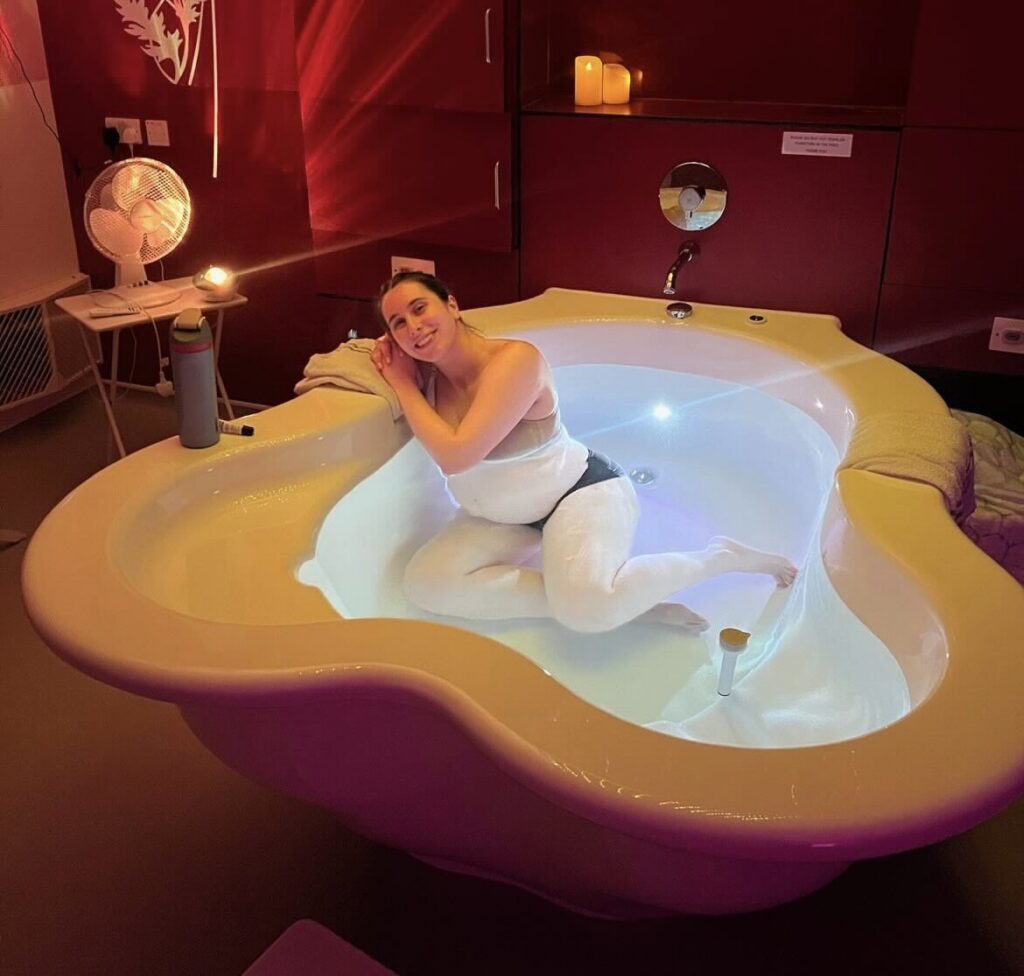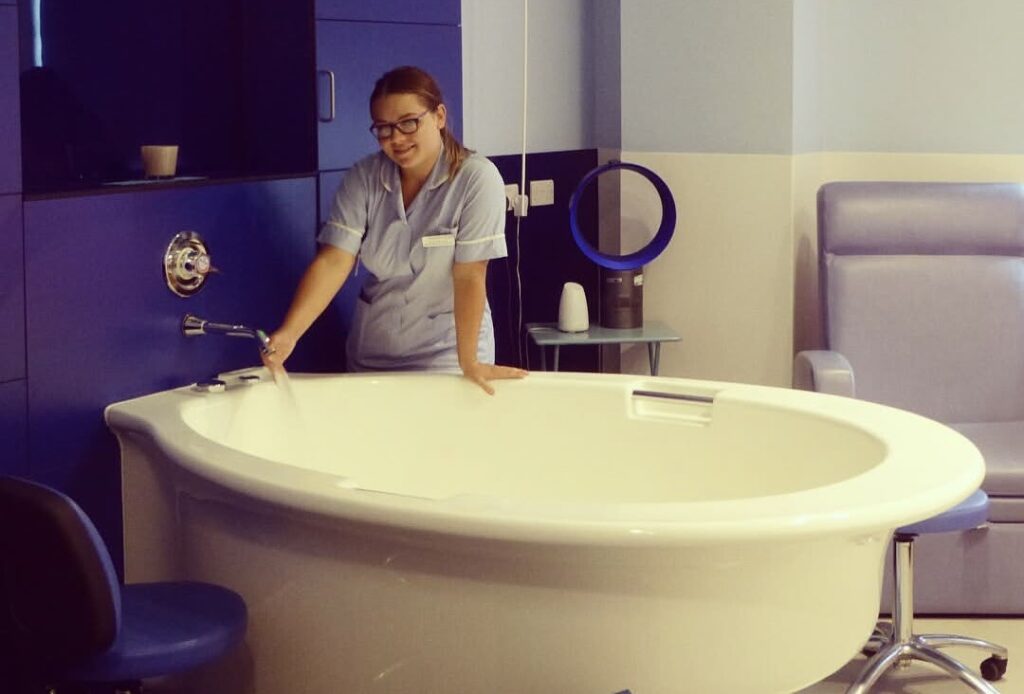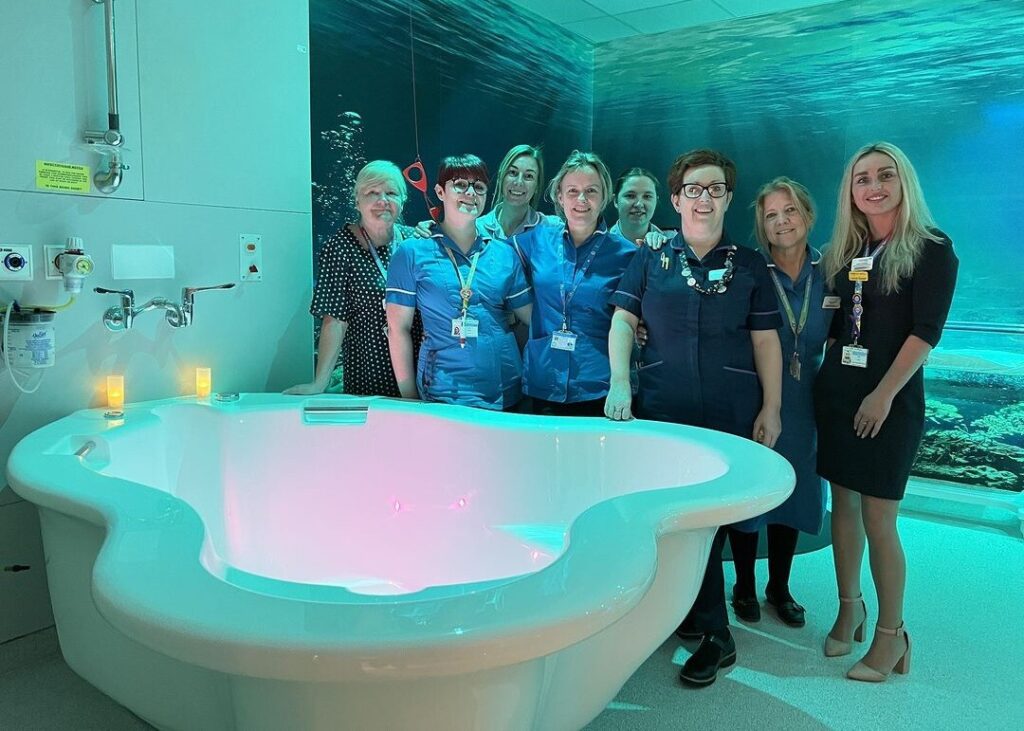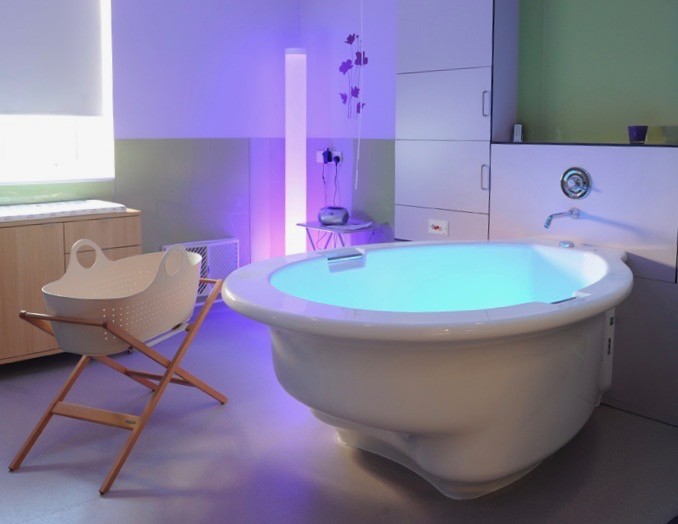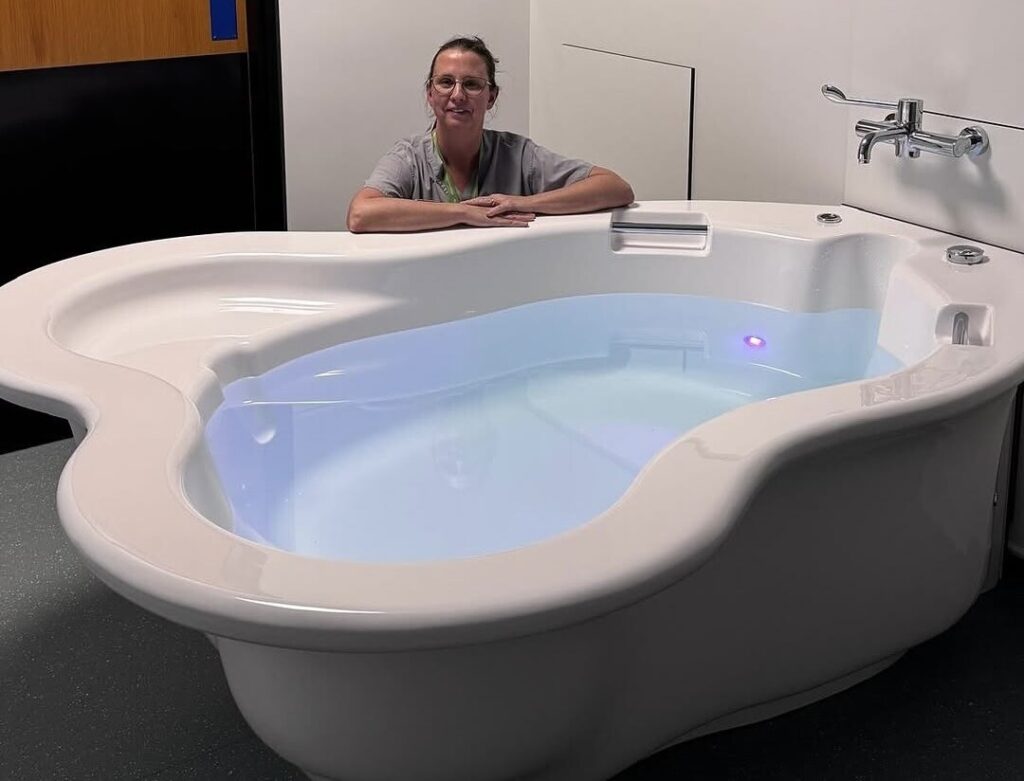

All women no matter what their shape or size find it exceptionally easy to get into our water birth pools.
Mothers don’t even think about it – they move instinctively and naturally lower themselves into the water.
Why safe access begins with the design of the pool itself
Entering a water birth pool should feel simple, instinctive and secure – never like an obstacle course.
For a mother in strong labour, who may be tired or less steady on her feet, the safest access method is one that reduces climbing, preserves balance and minimises the need for physical assistance.[1-4]
|
The Active Birth Pools solution A compact 15 cm single step and an extra-wide, rounded rim allow the mother to step up, sit down, swivel her legs into the pool and lower herself gently into the water. The movement is grounded, controlled and familiar, with three points of contact maintained through the transfer.[1,2] |
A simple movement – designed into the pool
The simple act of entering a birth pool is one of the most misunderstood aspects of water birth practice.
It should never create anxiety, require awkward manoeuvres or expose the mother or midwife to avoidable risk.[1,2]
Active Birth Pools were developed with manual handling, ergonomics and safe access in mind.
The design was considered with safety and manual handling expertise so that women of different shapes, sizes and fitness levels can enter with ease and with minimal need for assistance.[1,2]
Mothers do not need to climb over the pool.
They sit, swivel and lower themselves into the water in one natural, fluid sequence.
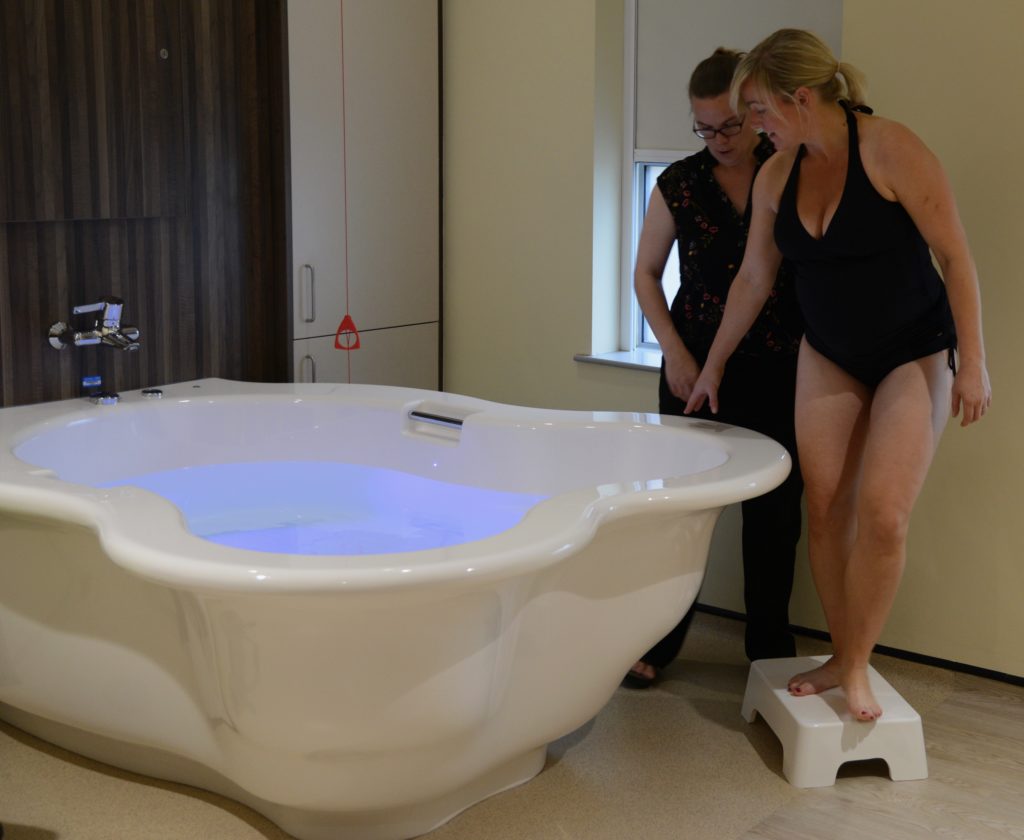
How the sit-and-swivel method works
1. Step onto the compact single step. The 15 cm height advantage lowers the effective rim height of a typical 75 cm Active Birth Pool to approximately 60 cm – comparable with an ordinary bath.
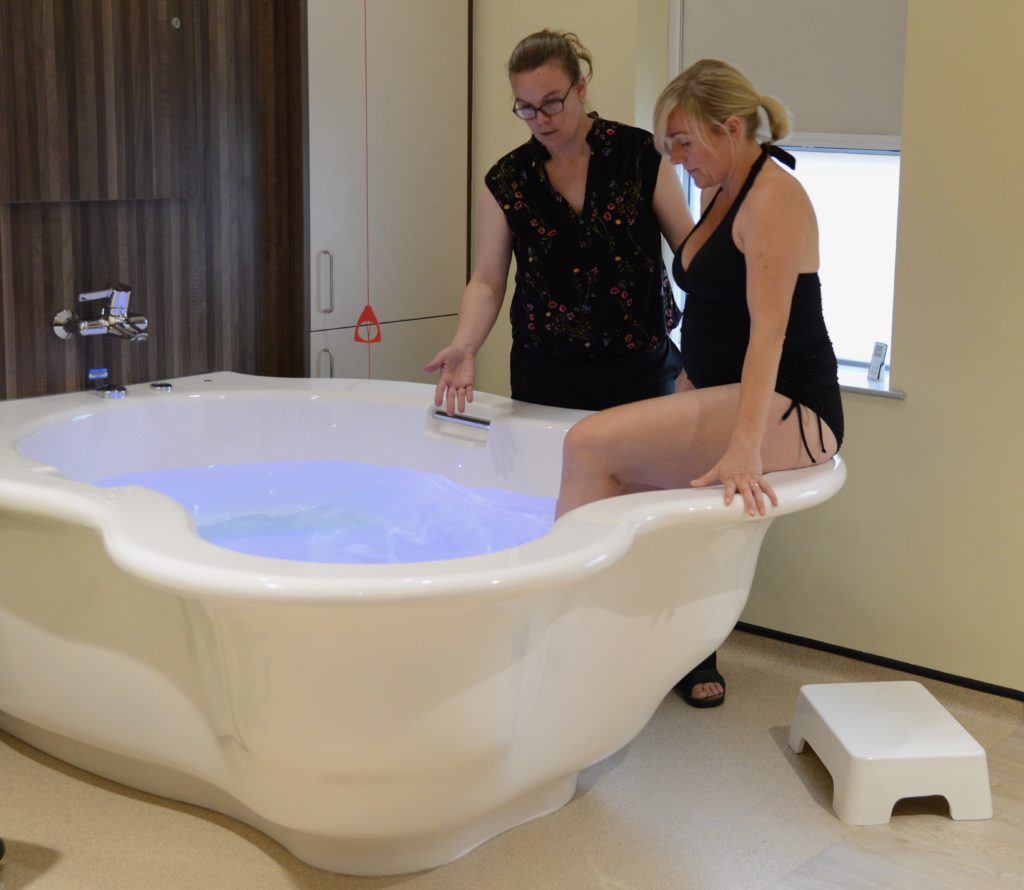
2. Turn and sit securely on the broad rim. The extra-wide, rounded rim provides a comfortable, supportive surface rather than a narrow edge.
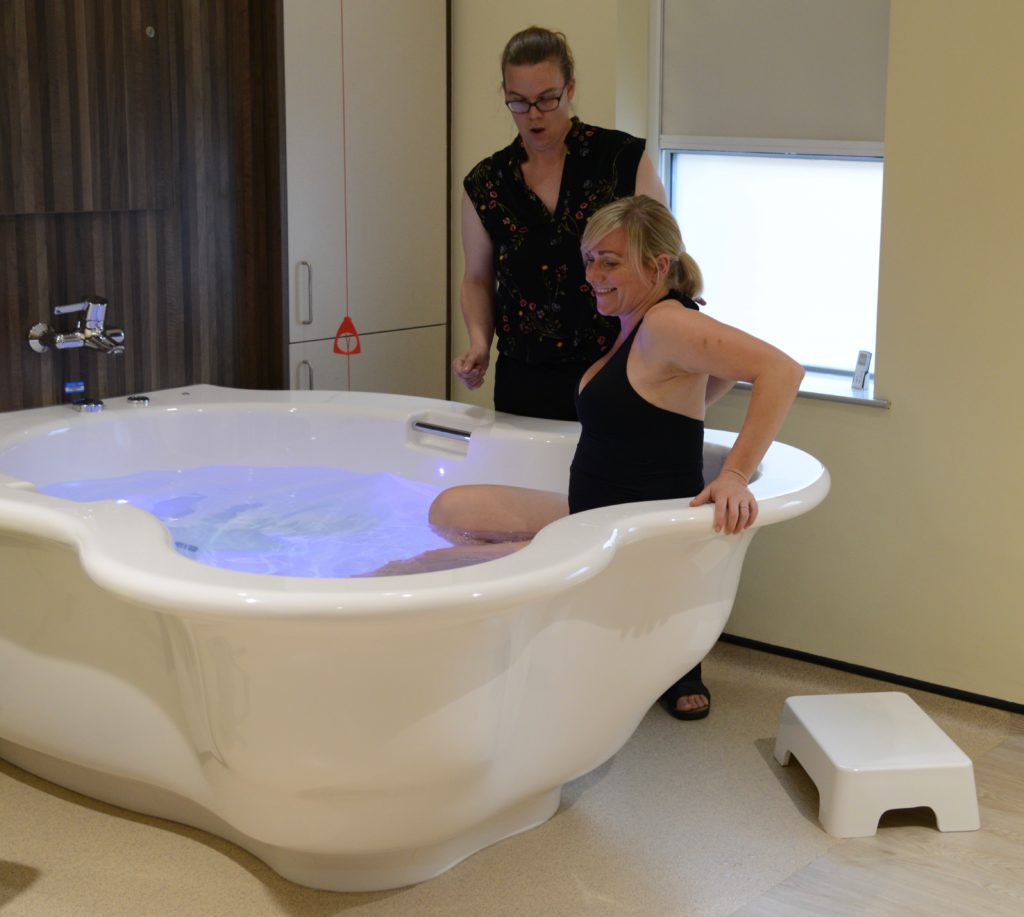
3. Swivel the legs into the water. The mother remains seated and grounded while moving her legs over the rim.
4. Lower gently into the pool. The movement can be paused and controlled, including if a contraction occurs during entry.[1,2]
Because the mother can maintain three points of contact, the transfer is more stable and less dependent on precise balance than climbing a multi-step unit, standing at height, stepping over a rim and descending into water.[2]
Why the single step makes such a difference
The single step is not intended to create a staircase.
Its purpose is simply to reduce the effective height of the pool rim before the mother sits down.
Used together with the wide rim, it supports a grounded transition into the water without requiring the mother to climb.[1,2]
Points of Information:
Protecting mothers and safeguarding midwives
HSE guidance identifies manual handling risks where staff actively support a mother’s entry or exit, or where the mother uses the midwife as a support.
HSE also advises that hazardous manual handling should be avoided where reasonably practicable and that unavoidable risks should be assessed and reduced.[3-6]
The sit-and-swivel method addresses the issue at source.
By replacing a climb-and-step-over sequence with a seated transfer, it reduces the likelihood that a midwife will need to steady, lift, catch or become a handhold for a mother who is tired, contracting or unsteady.[2,3]
This matters because an unexpected loss of balance can place a sudden and unpredictable load through a midwife’s back, shoulder or arm.
Good pool design should minimise that foreseeable people-handling risk rather than relying on staff strength or reaction.[2,3,6]
Why multi-step entry systems deserve careful scrutiny
There is a widespread assumption that a large step unit with handrails must be the safest way to enter and leave a birth pool.
In practice, such systems are often required because the pool has a narrow rim or a high, straight-sided profile that cannot support a seated transfer.[1,2,7-9]
A multi-step system may look reassuring, but the whole movement sequence should be considered.
A mother may need to climb, turn or reposition, step over the rim and descend into water – potentially finding a submerged floor, seat or plinth while her balance, concentration and coordination are affected by strong labour.[2]

Wet-room conditions change the risk
A birth room containing a pool is a wet clinical environment.
Even with careful housekeeping, the mother may have wet feet and water may be present around the access point.
Strong labour can also alter movement: a mother may pause suddenly, close her eyes, grip, squat, lean or become temporarily unable to follow a sequence of instructions.[2,10]
An access method should therefore allow her to stop safely.
With sit-and-swivel entry, she can pause while seated on the rim.
The risk is different if a contraction begins while she is part-way up a step unit or standing as she negotiates the pool edge.[2]
Clear space around the pool matters
A bulky step unit does not disappear after entry.
If left beside the pool, it occupies working space in the area where midwives, partners and equipment need to move.
If moved away, it creates another lifting, cleaning, drying and storage task.[2,7]
The compact Active Birth Pools step provides the required height advantage without obstructing the midwife’s free movement.
This helps keep the poolside clearer for observation, support and emergency access.[1,2]
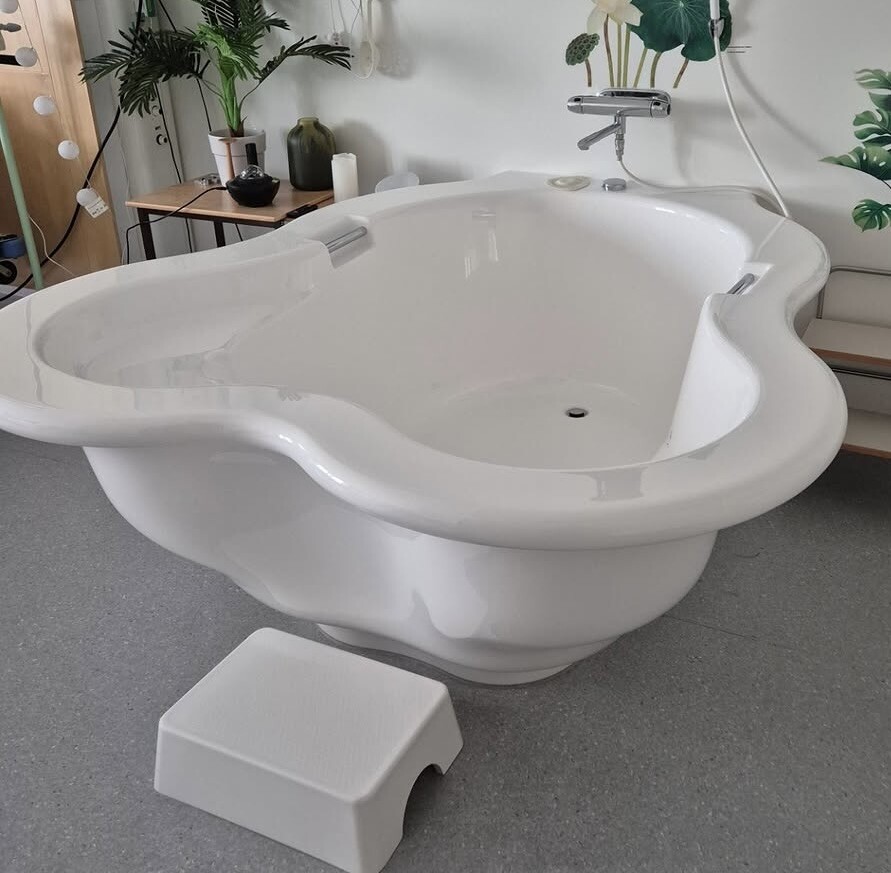
Entering a water birth pool should be easy enough that the mother barely needs to think about it.
Active Birth Pools’ extra-wide rim and compact single step support an instinctive sequence: step, sit, swivel and lower.
The mother remains grounded; the midwife is less likely to become a physical support point; and the space around the pool remains clearer.[1-3]
For mothers in strong labour, for midwives working in a wet clinical environment and for hospitals seeking to reduce manual handling and trip risks, safe access should be designed into the pool from the outset.[2-6]
References
1. Active Birth Pools. Sit and Swivel – the Natural Way to Enter a Water Birth Pool. Accessed 14 June 2026.
2. Active Birth Pools. Manual Handling Assessment: Safe Entry and Exit for Hospital Water Birth Pools. 2026.
3. Health and Safety Executive. Manual handling in birthing pools. Updated 12 January 2026.
4. Health and Safety Executive. Moving and handling in health and social care. Updated 12 January 2026.
5. Health and Safety Executive. Manual handling at work: overview. Updated 25 March 2024.
6. Health and Safety Executive. Manual handling at work: reduce the risk of injury. Updated 1 April 2025.
7. Croyde Medical. Croyde Universal Birth Pool Steps. Accessed 14 June 2026.
8. Febromed. CombiPool. Accessed 14 June 2026.
9. Seagull Medica. Birthing tubs. Accessed 14 June 2026.
10. Milton Keynes University Hospital NHS Foundation Trust. Guideline for the Use of Water During Labour and Birth. 2022.