
A practical guide for maternity teams, estates departments, infection-prevention specialists, Water Safety Groups, designers and contractors
Core message: A birth pool should be treated as part of the healthcare water system. Safe design removes avoidable stagnation, keeps services simple and accessible, supports fresh filling for each use, and makes complete drainage, cleaning and monitoring easier.
Water safety and Legionella control for hospital birth pools
Hospital birth pool water safety begins long before the pool is filled. It depends on the design of the hot- and cold-water system, the route and frequency of water use, the position of outlets, the ability to drain and dry the pool, and the procedures used by maternity, estates and infection-prevention teams.
Legionella and other waterborne microorganisms can multiply where water is allowed to stagnate, where temperatures support growth, or where deposits and biofilm provide protection. In a maternity setting, the objective is not to treat the pool as an isolated product, but to integrate it into the hospital’s wider Water Safety Plan and system of control.
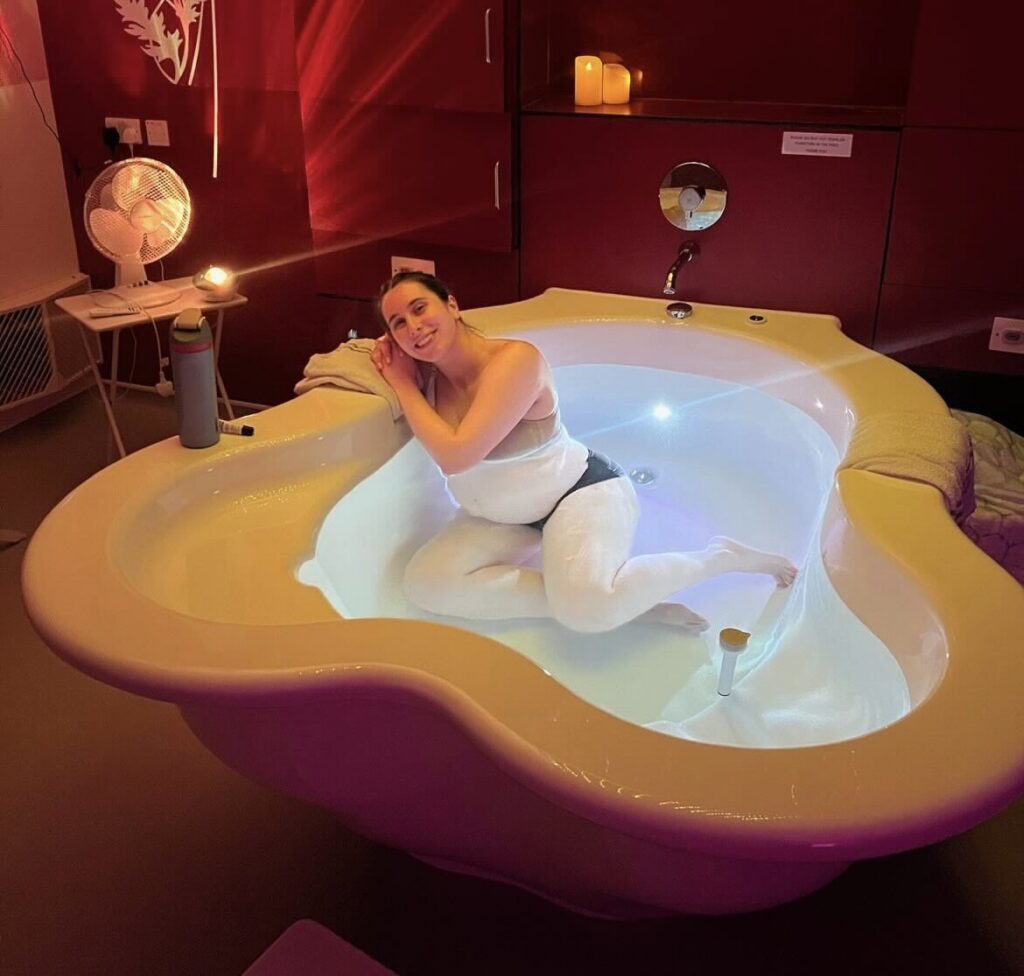
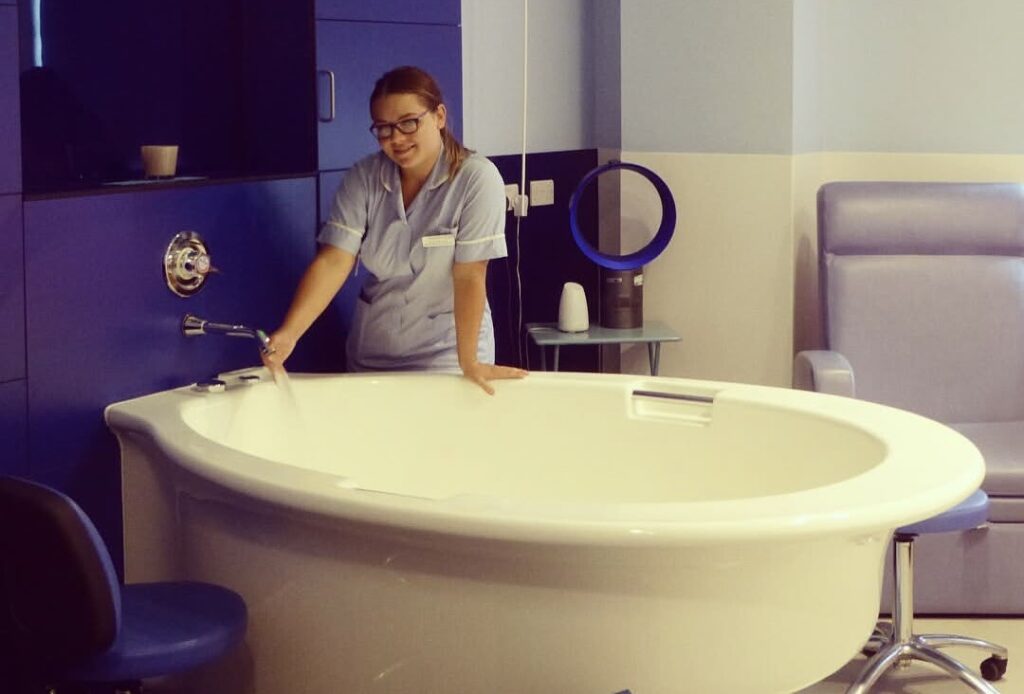
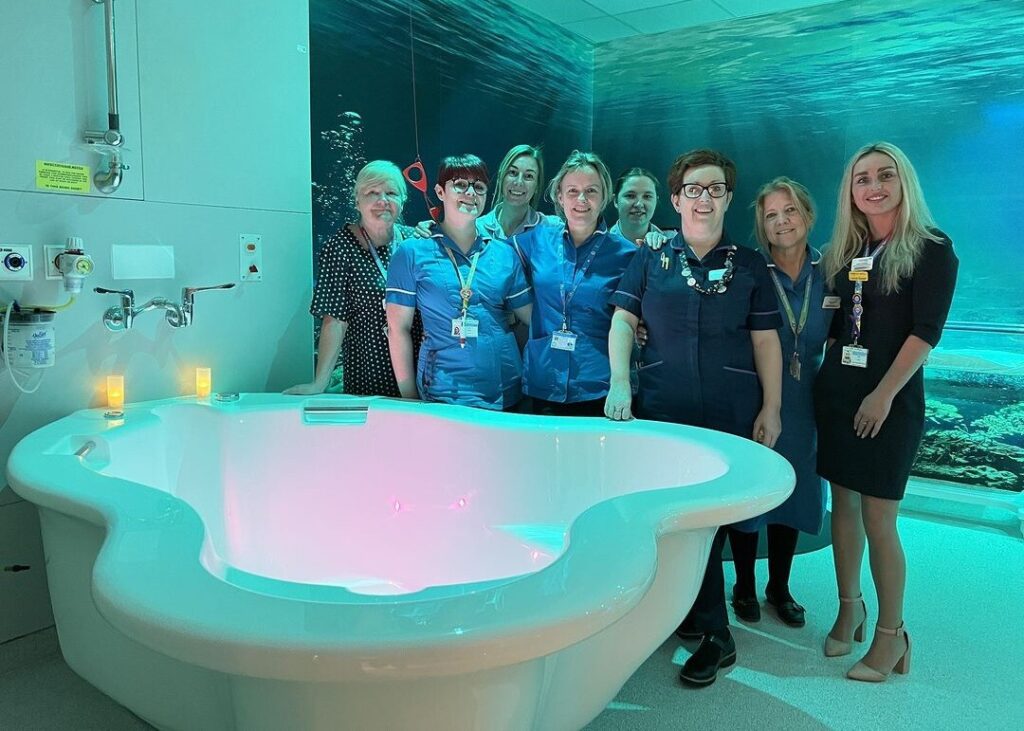
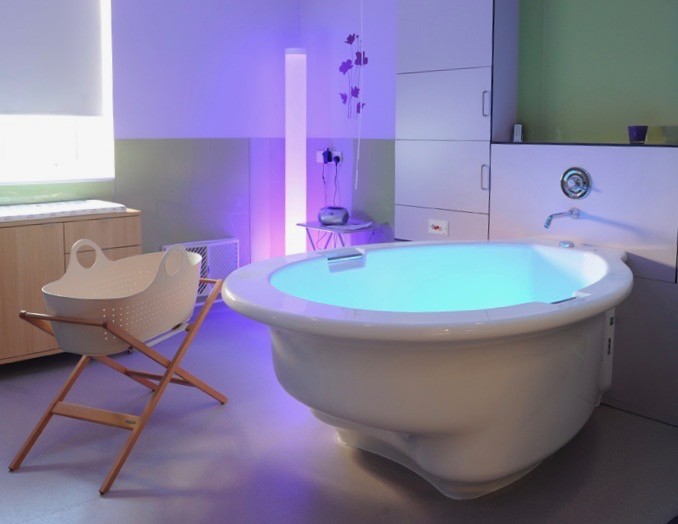
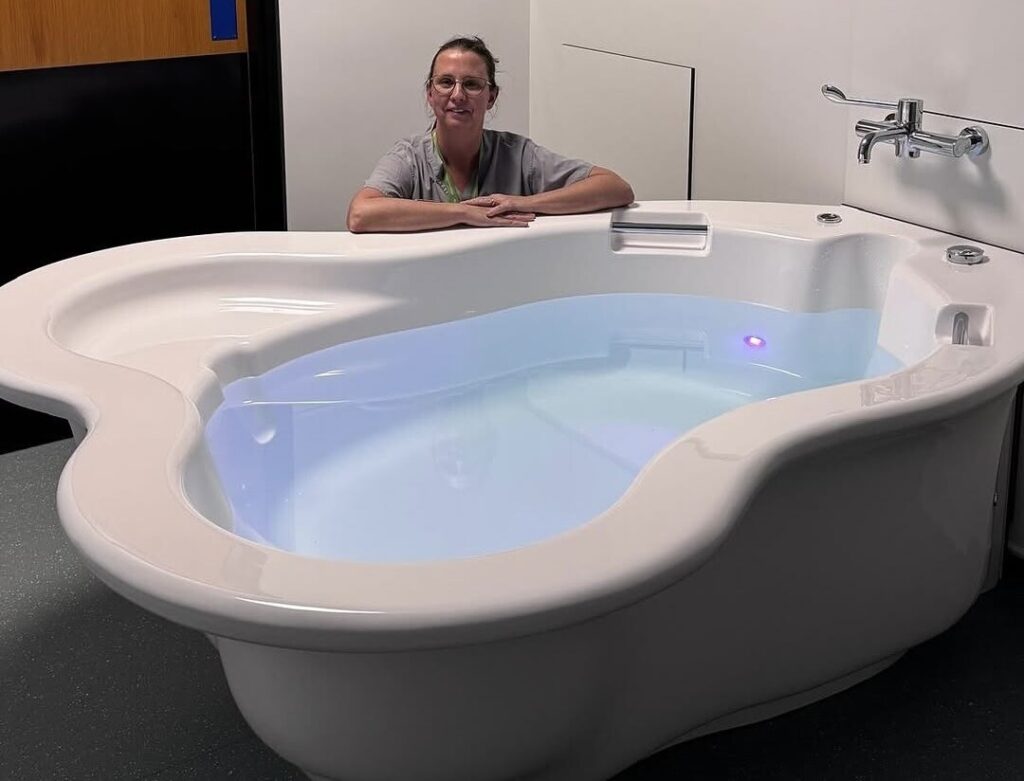
Active Birth Pools are purpose-designed hospital sanitary ware. They are intended to be filled with fresh mains water for each labour, emptied after use, cleaned and disinfected in accordance with local protocols and the manufacturer’s guidance. They are not recirculating spa pools and should not be operated as continuously heated or prefilled systems.
Why Legionella control matters in maternity environments
Legionella bacteria occur naturally in water and may grow in engineered systems when conditions are favourable. The Health and Safety Executive identifies temperature, stagnation, scale, sediment and biofilm as important risk factors. Control therefore depends on design, operation, maintenance, monitoring and clear responsibility. [1][2]
Birth pools deserve particular attention because warm water is used close to a mother and newborn. Published investigations have linked neonatal legionellosis with prefilled, heated and recirculating birthing tubs. These rare but serious cases reinforce a fundamental distinction: a hospital birth pool should be freshly filled for the individual mother and should not behave like a warm-water storage or spa system. [5][6]
The lesson is not that water birth itself creates Legionella. The risk arises when the water system, fittings or operating method allow microorganisms to grow and then expose the mother or baby.
Bring the birth pool into the hospital Water Safety Plan
NHS guidance in HTM 04-01 applies to the design, installation, commissioning, operation and maintenance of hot- and cold-water systems in healthcare premises. It is written for healthcare management, Water Safety Groups, design engineers, estates managers, operations managers, contractors and supply-chain businesses. [3]
The birth pool and its associated pipework, valves, outlets, hoses and drainage should therefore be considered by the Water Safety Group from the earliest design stage. Responsibility should not be divided between the maternity room designer, plumber, equipment supplier and clinical team without a single coordinated assessment.
The project should identify who owns the risk assessment, who approves the design, who commissions the system, who manages flushing and temperature monitoring, and who authorises the pool for clinical use.
Design out stagnation and unnecessary complexity
The safest water system is generally the simplest one that meets the clinical need. Long pipe runs, blind ends, oversized distribution pipework, seldom-used branches and redundant fittings can create areas of low flow or stagnation. HSE guidance emphasises designing, maintaining and operating water services to prevent or adequately control Legionella growth. [2]
Birth-pool services should be routed as directly as practicable, with accessible isolation, commissioning and maintenance points. Any arrangement that may hold warm water between uses should be challenged during design review.
The pool itself should have a free-flowing outlet and should drain completely. Surfaces and fittings that trap residual water make drying more difficult and can undermine an otherwise sound cleaning procedure.
Use fresh water for every labour
A hospital birth pool should be filled shortly before use with fresh water from the approved healthcare water system. It should not be filled in advance and held warm while waiting for a mother, and water should not be stored or recirculated between users.
Fresh filling reduces the opportunity for organisms to multiply in the pool water. It also makes the start of each use clear and auditable: the pool has been cleaned, rinsed as required, freshly filled and checked before the mother enters.
The filling time should be fast enough for clinical practicality without encouraging the unit to keep the pool prefilled. Appropriate flow rates and correctly sized services are therefore part of infection prevention as well as convenience.
Control water temperature without creating avoidable risk
HSE guidance notes that Legionella can grow in water systems between approximately 20°C and 45°C, particularly where stagnation is present. Temperature control in the building system is therefore a central control measure. [4]
Healthcare hot-water systems are normally managed at temperatures that limit bacterial growth, with safe delivery temperatures achieved at the point of use by an appropriate thermostatic arrangement. The specific design must follow HTM 04-01, local Water Safety Plan requirements and the project engineer’s assessment. [3]
The temperature used for labour is a separate clinical requirement. NICE recommends monitoring the woman’s temperature and the water temperature hourly, and states that the pool water should not be above 37.5°C. [7] Mixing for maternal comfort should occur at filling and use, not by maintaining a reservoir of lukewarm water within the system.
Position taps, spouts and hoses carefully
Outlets are critical parts of the water system. Their design and position affect flushing, cleaning, splash, aerosol generation, access and the possibility of contamination from hands or the pool environment.
Fittings should be selected for healthcare use and positioned so that they can be inspected, cleaned, maintained and replaced. They should not create hidden cavities or inaccessible water traps around the pool rim.
Flexible hoses require particularly careful governance. A hose that is left containing water, stored wet, allowed to touch the pool water or used for more than one purpose can become a contamination route. Where a hose is required, the Water Safety Group should approve its specification, storage, flushing, cleaning, replacement interval and connection arrangement. The design should also protect the mains supply from backflow in accordance with water regulations and local engineering requirements.
Manage little-used outlets and periods of low activity
Birthing rooms may have irregular patterns of use. A pool that is clinically important may still remain unused for days or weeks. The associated outlets must therefore be included in the hospital’s programme for little-used water services.
Local procedures should define flushing frequency, the volume or duration of flushing, responsibility, safe disposal to drain and record keeping. Flushing should be carried out in a way that avoids unnecessary aerosol and does not expose patients or staff to hot water.
After closure, refurbishment, commissioning work or an extended period of non-use, the pool services should be assessed and returned to use under the Water Safety Plan rather than simply opened and filled.
Drain, clean and dry after every use
Once the mother has left the pool, water should be discharged promptly through the designated drainage system. The pool should then be cleaned and disinfected using the local protocol agreed with infection prevention or microbiology and in accordance with the manufacturer’s guidance. NICE expressly requires this approach for birthing pools. [7]
Cleaning and disinfection are separate steps. Organic material and visible soil must be removed so that the disinfectant can act on the surface. Staff must use the correct product, concentration and contact time and must follow any rinsing requirement.
The design should allow all internal surfaces, the outlet and accessible fittings to be reached. After the procedure, residual water should not remain trapped in the pool or its accessories. A clean, dry pool provides a clear starting point for the next use.
Commissioning and handover are essential
A well-designed installation can still be compromised if debris, flux, construction contamination or stagnant commissioning water is left in the system. The birth-pool installation should be commissioned as part of the healthcare water system, not treated as a final decorative fitting.
Handover information should include as-installed drawings, valve and outlet identification, flushing points, cleaning instructions, product data, commissioning results, risk controls, maintenance requirements and the agreed operating procedure.
Maternity staff should understand what they are expected to check. Estates and infection-prevention teams should know which components require planned inspection, servicing, sampling or replacement.
Monitoring, records and response to concerns
An effective control scheme is supported by records. These may include flushing logs, temperature checks, servicing, cleaning records, microbiological sampling where indicated, corrective work and Water Safety Group review.
Routine Legionella sampling is not a substitute for good control. HSE guidance explains that testing should be based on the risk assessment and control scheme and carried out by competent people using appropriate methods. [8]
If results, temperatures, flow conditions or clinical observations suggest a problem, the pool should be managed under the organisation’s Water Safety Plan. This may include taking the outlet out of use, investigation, remediation, verification and formal approval before return to service.
Active Birth Pools: design principles that support water safety
Active Birth Pools are designed as fixed hospital sanitary ware with smooth, seamless internal surfaces and straightforward filling and drainage. The pools use fresh water for each labour and do not depend on pumps, jets, filters or recirculation systems.
Separating the water controls from the principal working rim can improve access for cleaning and maintenance. The Water Column option provides a dedicated location for services on freestanding installations, while wall-mounted arrangements can be integrated with an appropriate clinical-services panel.
The final safety of any installation depends on correct specification, installation, commissioning and operation within the hospital’s Water Safety Plan. Product design supports that system; it does not replace it.
Design principle: Do not manage waterborne risk by relying on cleaning alone. Begin with a simple, free-flowing system that avoids stored warm water, unnecessary pipework, inaccessible fittings and residual water.
A practical specification checklist
- Include the birth pool and its services in the healthcare Water Safety Plan and Legionella risk assessment.
- Obtain Water Safety Group input before the layout and water-service design are fixed.
- Use a direct, appropriately sized hot- and cold-water supply with no avoidable dead legs or redundant branches.
- Provide suitable temperature control in accordance with HTM 04-01 and the local engineering strategy.
- Specify healthcare-appropriate outlets that can be accessed for inspection, cleaning, maintenance and replacement.
- Assess any flexible hose as a water-safety component and define its storage, flushing, cleaning and replacement arrangements.
- Provide backflow protection appropriate to the installation and local water regulations.
- Ensure the pool fills quickly enough to avoid operational pressure to prefill it.
- Use fresh water for each labour; do not store, continuously heat or recirculate pool water.
- Ensure the pool and outlet drain completely and can be cleaned and dried without inaccessible water traps.
- Include little-used outlets in the flushing and monitoring programme.
- Commission, document and approve the installation before clinical use.
- Give maternity staff clear operating, cleaning and escalation procedures.
- Keep records and review performance through the Water Safety Group.
Frequently asked questions
Can Legionella grow in a birth pool?
Legionella can multiply in water systems where temperatures, stagnation, scale, sediment or biofilm support growth. A freshly filled, promptly emptied and properly maintained hospital pool presents a very different operating condition from a prefilled or recirculating heated tub. The full installation still requires risk assessment and control.
Are birth pools covered by HTM 04-01?
The pool’s hot- and cold-water services form part of the healthcare water system. Their design, installation, commissioning, operation and maintenance should be managed in line with HTM 04-01, HSE guidance and the organisation’s Water Safety Plan.
Does the pool need Legionella testing after every use?
No general rule requires testing after every use. Sampling should be determined by the risk assessment, control scheme and Water Safety Group. Monitoring temperatures, flow, flushing and maintenance remains essential.
What is the safest type of birth pool for a hospital?
A purpose-designed fixed pool with smooth, accessible surfaces, complete drainage and no pumps, jets, filters or recirculating water avoids many of the complexities associated with spa-style systems. The surrounding water-services design is equally important.
Who should approve the installation?
Approval should involve the hospital’s Water Safety Group together with maternity, estates, infection prevention, the Authorising Engineer or other competent water-safety adviser where applicable, designers, installers and the pool supplier.
How should a birth pool be cleaned?
Follow a local protocol agreed with infection prevention or microbiology and the manufacturer’s guidance. Remove visible contamination first, use the approved disinfectant at the correct concentration and contact time, rinse when required, drain completely and leave the pool clean and dry.
Are Active Birth Pools medical devices?
No. Active Birth Pools are purpose-designed hospital sanitary ware. They should be specified as part of the maternity room and its water, drainage, cleaning and maintenance systems.
Plan a safer hospital water birth installation
Active Birth Pools can provide dimensions, technical drawings, installation guidance and project support for maternity teams, architects, estates departments, Water Safety Groups and contractors. Early coordination helps ensure that the pool, outlets, Water Column or services panel, drainage and room layout form one coherent system.
References and source notes
- Health and Safety Executive. Legionnaires’ disease: The control of legionella bacteria in water systems. Approved Code of Practice and guidance, L8, fourth edition. https://www.hse.gov.uk/pubns/books/l8.htm
- Health and Safety Executive. Legionnaires’ disease: Technical guidance, HSG274, second edition, March 2024; including Part 2 on hot- and cold-water systems. https://www.hse.gov.uk/pubns/books/hsg274.htm
- NHS England. Health Technical Memorandum 04-01: Safe water in healthcare premises, Parts A, B and C. Publication page updated 27 August 2024. https://www.england.nhs.uk/publication/safe-water-in-healthcare-premises-htm-04-01/
- Health and Safety Executive. Hot and cold water systems; and guidance on preventing or controlling Legionella risk. Updated 2024. https://www.hse.gov.uk/legionnaires/hot-and-cold.htm
- Collins SL, et al. Fatal Legionellosis after Water Birth, Texas, USA, 2014. Emerging Infectious Diseases. 2015;21(1). https://wwwnc.cdc.gov/eid/article/21/1/14-0846_article
- Public Health England. Neonatal Legionnaires’ disease associated with a water birth in a domestic spa pool, England, 2014. Health Protection Report and related investigation, cited in the published case literature.
- National Institute for Health and Care Excellence. Intrapartum care, NICE guideline NG235, recommendations 1.6.10–1.6.12. Updated 2025. https://www.nice.org.uk/guidance/ng235/chapter/Recommendations
- Health and Safety Executive. Testing and monitoring your water system for Legionella. Updated 30 September 2024. https://www.hse.gov.uk/legionnaires/testing-monitoring-water-system.htm
- Active Birth Pools. Product, cleaning, care and installation guidance. https://activebirthpools.com/
Editorial note: This page provides general design and governance information. It should not replace a site-specific Legionella risk assessment, the hospital Water Safety Plan, HTM 04-01, HSE guidance, local infection-prevention procedures or professional engineering advice.