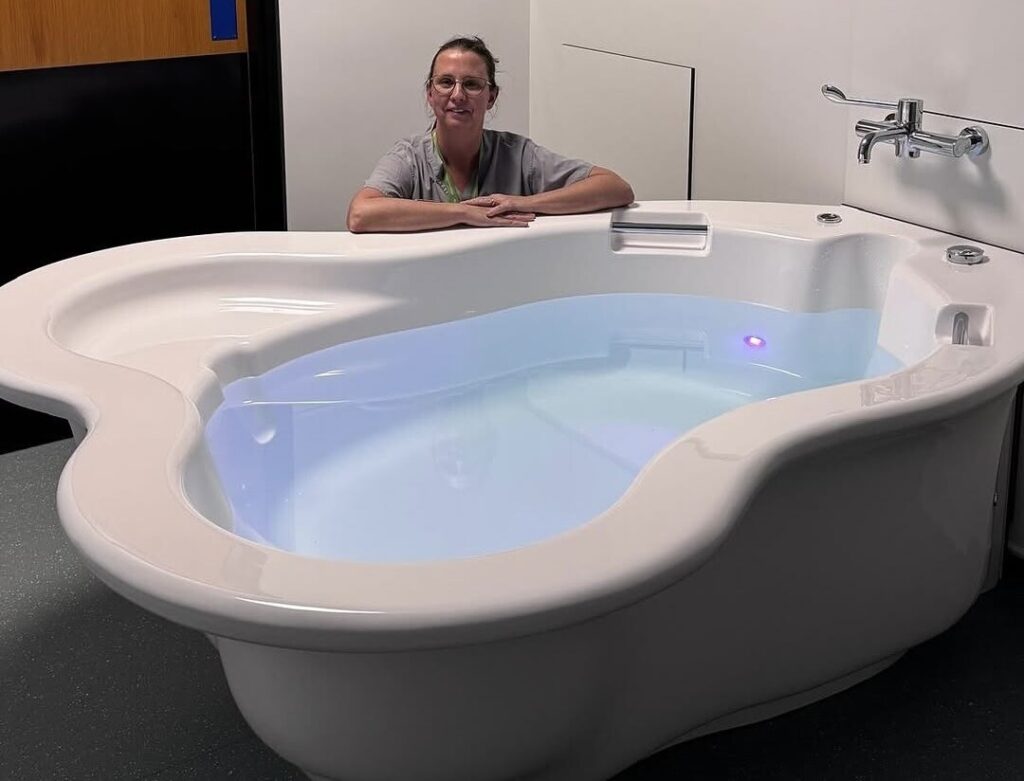

There is a subject that maternity planning does not always address openly or often enough.
Many women enter labour carrying more body weight, living with restricted mobility, experiencing pelvic or joint discomfort, or simply finding it difficult to kneel, squat, turn and remain upright for extended periods. This includes women who are described clinically as overweight or obese, women who identify as large or plus size, and women of any size whose movement is limited by pregnancy, pain, disability, fatigue or other physical factors.
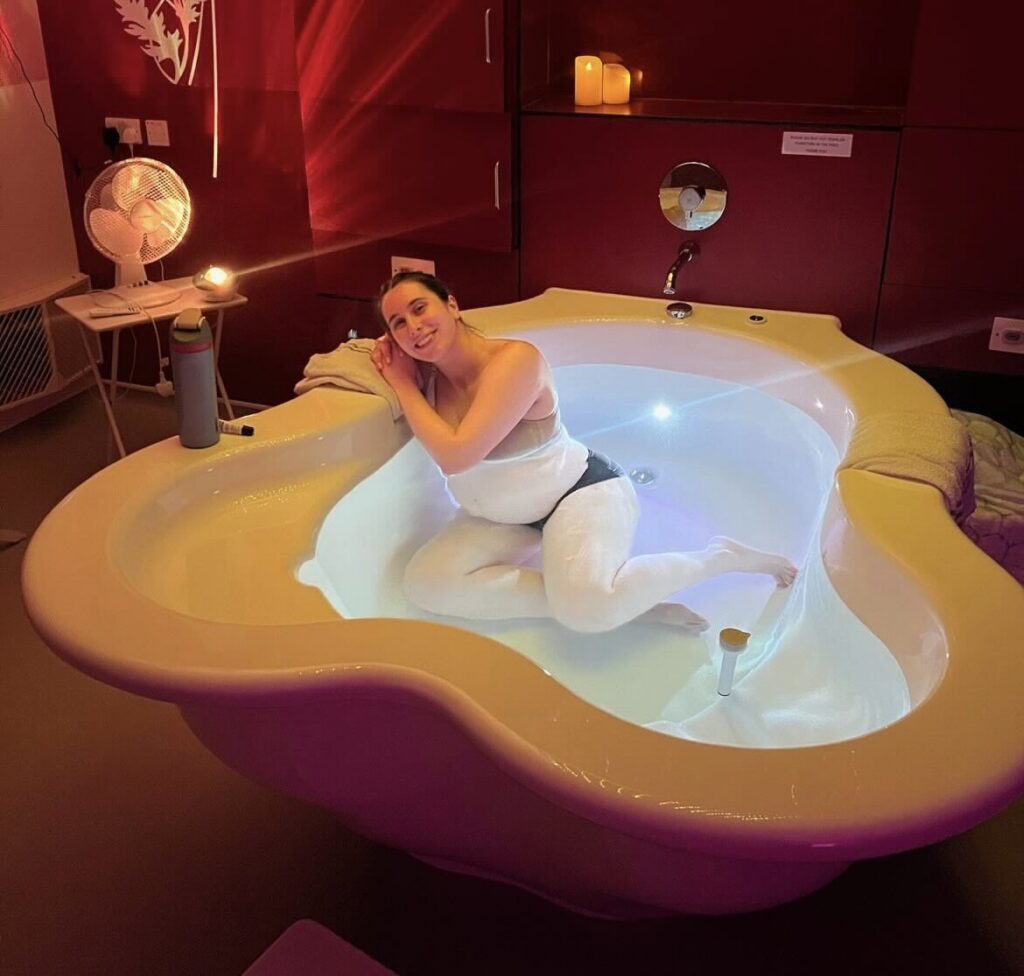
These mothers may be among those who stand to gain most from the buoyancy, support and freedom of movement provided by a properly designed water birth pool.
Yet they are also among the women who may be least likely to be offered access to water during labour and birth. Research from England has found that women recorded as obese were less likely to give birth in water.[1] In some maternity services, body mass index thresholds have historically been used to restrict access, even where a woman’s individual circumstances might otherwise allow water immersion to be considered.
This deserves closer examination.

The physical reality of labour on land
Women are commonly encouraged to remain mobile and to adopt upright, forward-leaning, kneeling, side-lying or asymmetrical positions during labour. The World Health Organization recommends encouraging mobility and upright positioning during labour for women at low risk.[2] NICE also advises that upright positions and keeping mobile may be beneficial for women without an epidural during the second stage of labour.[3]
These recommendations are physiologically sound, but they can be difficult to put into practice.
For a larger woman, moving from standing to kneeling, maintaining a supported squat, turning from one side to another or getting up from the floor may require considerable muscular effort. The weight of the abdomen, pressure on the knees and hips, reduced balance, breathlessness and fatigue can all limit the positions that feel achievable.
A woman may understand the value of mobility but still be physically unable to sustain the postures that feel most natural during labour. This is not a failure of motivation. It is an environmental and ergonomic challenge.
A birthing room that offers only a bed, chair, floor mat or standard bath may unintentionally restrict the mother’s choices. When changing position becomes difficult, she may spend longer reclining or lying on the bed, not because this is instinctively right for her, but because other options are uncomfortable, exhausting or inaccessible.
Water can make freedom of movement possible when movement on land is difficult.
Buoyancy changes what the body can do
Immersion in sufficiently deep water changes the physical experience of movement.
Buoyancy partially supports the mother’s body, reducing the load placed on her muscles and weight-bearing joints. Warm water can promote relaxation, ease muscular tension and make it easier to turn, kneel, lean forward, sit, squat or float between positions.
A systematic review and meta-analysis of water immersion during labour found benefits for healthy women and their newborns and associated immersion with reduced use of several intrapartum interventions.[4] Reviews also describe warm water as supporting relaxation, comfort and easier movement between positions.[4,5]
For a woman who finds movement difficult on land, this support may be transformative.

In water, she may be able to:
- turn without having to lift her full body weight;
- move from sitting to kneeling with less strain;
- lean forward while the water supports her abdomen;
- widen or adjust her knees and hips more comfortably;
- rock or rotate her pelvis during contractions;
- adopt asymmetrical positions;
- rest while remaining upright and immersed;
- change position more frequently without exhausting herself.
The objective is not to prescribe one “correct” birthing position. It is to create an environment in which the mother can explore movement, follow her instincts and find the position that feels right at each stage of labour.
Depth is essential
Not every pool provides the same degree of buoyancy.
For water to support the body effectively, it must be deep enough for meaningful immersion. A shallow bath may provide warmth and some pain relief, but it cannot reproduce the same freedom of movement as a purpose-designed pool with adequate water depth.
Active Birth Pools typically provide a water depth of approximately 640–650 mm when filled to the specified operating level, depending on the model.[6,7] This depth allows the water to support a substantial proportion of the mother’s body when she is kneeling, sitting, squatting or leaning forward.
For larger mothers, adequate depth is particularly important. If the water level is too low, the abdomen, shoulders and upper body remain unsupported and the mother must continue carrying much of her weight through her legs, knees and arms.
The value of a birth pool is therefore not determined simply by whether it holds water. Its internal depth, dimensions, contours and support features determine how effectively the mother can use buoyancy.

Space matters too
A pool can be deep but still restrict movement if it is too narrow, too short or poorly shaped.
Larger women need sufficient internal room to turn, widen their knees, change the direction in which they are facing and move between upright, kneeling, forward-leaning and resting positions. They should not feel enclosed, wedged into one position or concerned about colliding with taps, fittings or protruding accessories.
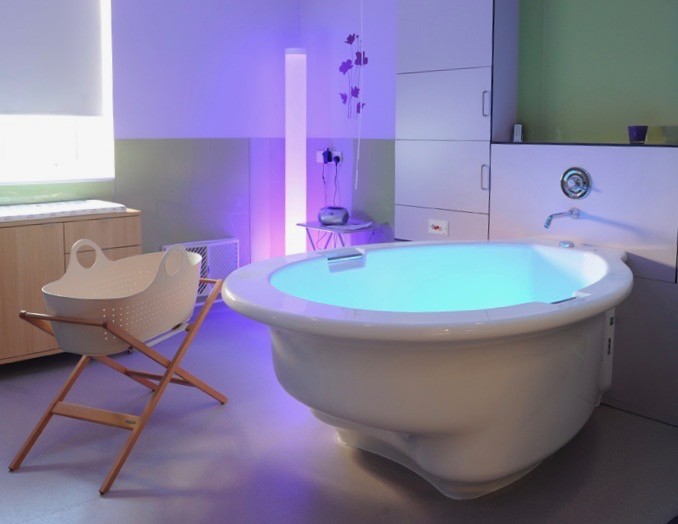
Active Birth Pools are designed with open internal space and smooth, flowing contours. Different models accommodate different room sizes and clinical requirements, with the larger Active pool offering particularly generous internal dimensions.[6]
The absence of unnecessary obstructions allows the mother to move without continually having to negotiate equipment inside the pool.
This is an important distinction between a purpose-designed water birth pool and a large bath. The aim is not simply to contain the mother. It is to create a supportive environment for active labour.
Support should be available wherever the mother needs it
Buoyancy provides freedom, but mothers also need stable points of support.
During a contraction, a woman may want to pull, brace, lean, grip or rest. These instinctive actions can help her feel secure and in control. They are particularly valuable for women who may be less confident about their balance or who find it difficult to support their body weight without assistance.
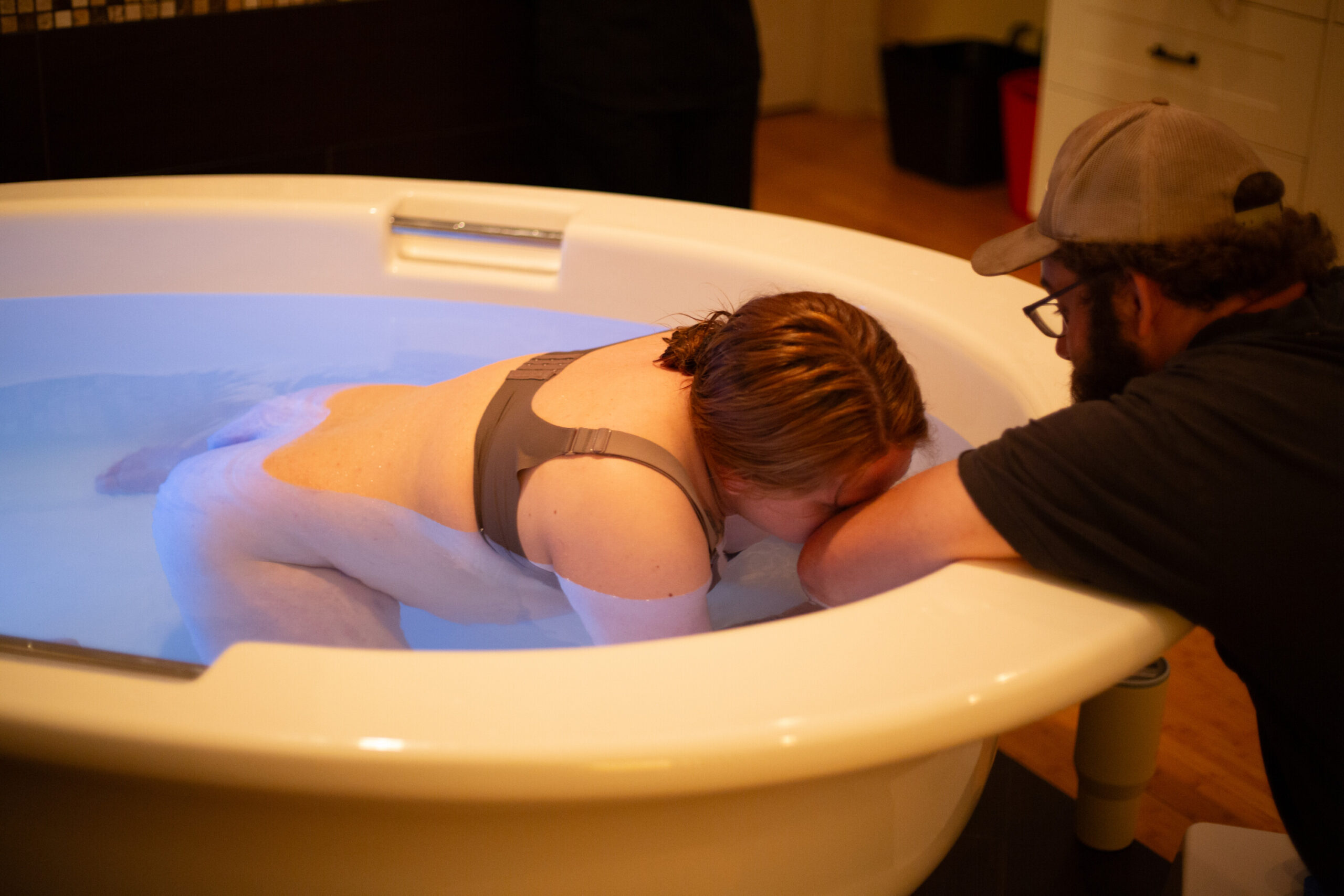
Active Birth Pools incorporate features such as:
- broad, rounded rims that can be held or leaned upon;
- integrated handholds or grab rails, depending on the model;
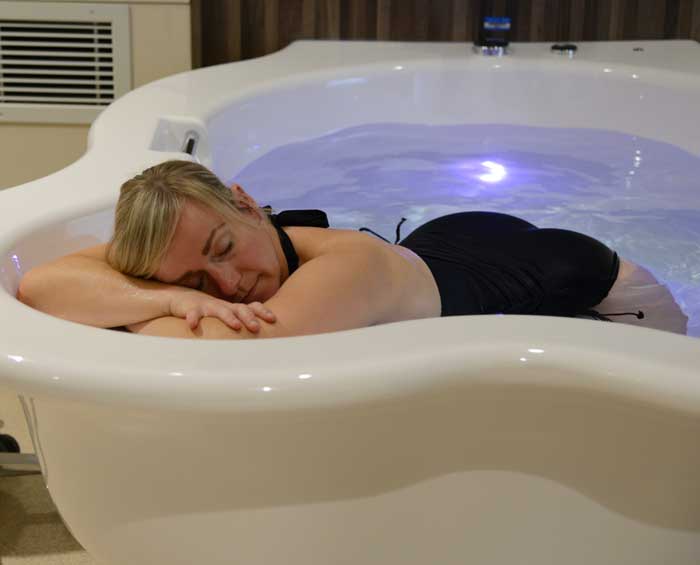
- submerged seats for resting while remaining immersed;
- lumbar and body support formed by the pool’s internal contours;
- space for forward-leaning and kneeling positions;
- stable entry and exit arrangements.
These features allow the mother to use the pool instinctively rather than having to follow complicated instructions.
A submerged seat can provide a place to pause and recover without leaving the water. A well-positioned handhold can help her rotate her pelvis or steady herself as she moves. A curved wall can support her back or shoulders. A broad rim can support forward leaning while allowing her abdomen to remain buoyant.
This combination of freedom and support is central to the Active Birth Pools design philosophy.

Protecting dignity and reducing unnecessary assistance
Larger and less-mobile women can sometimes find themselves surrounded by additional staff whenever they need to change position, get off a bed or move to another part of the room.
Although support should always be available when required, needing several people to assist with basic movement can leave a woman feeling exposed or dependent.
Inside a well-designed pool, buoyancy may enable her to make small and large positional changes herself. The mother can respond to her contractions privately and instinctively, with the midwife nearby rather than physically directing every movement.
NICE now specifically recommends supporting women and pregnant people with mobility issues to access water during labour and birth through individualised needs assessment and reasonable adjustments.[3] This is an important recognition that restricted mobility should not automatically be treated as a reason to withhold water. In some circumstances, it may be one of the strongest reasons to make water accessible.

Health, safety and ergonomics must be designed in
For larger or less-mobile women, a well-designed pool can contribute to this safer system by enabling more self-directed movement and by reducing foreseeable demands on staff to lift, pull, hold or reposition a woman’s body weight. The aim is not “no handling” at any cost. It is to avoid unnecessary handling and to make any assistance that remains necessary planned, proportionate and safer.
An ergonomic approach asks whether the environment is compatible with the capabilities and limitations of the people who use it. In maternity care, this includes the mother, midwives, maternity support workers and any staff who may be needed in an urgent situation. Human-factors guidance emphasises improving safety through system and equipment design, rather than relying only on individuals to compensate for a poorly designed environment.[13]
The Manual Handling Operations Regulations 1992 require employers, so far as is reasonably practicable, to avoid hazardous manual handling, assess operations that cannot be avoided and reduce the risk of injury.[10,11] HSE guidance for health and social care applies this approach to the movement and support of people because poor practice can injure both the person receiving care and the staff assisting them.[12]
Health and safety is not achieved simply by asking staff to use a “good lifting technique”. It begins with the design of the task, the room, the equipment and the care pathway.
Entry and exit must be designed around real women
Access to the pool is not a minor operational detail.
For larger and plus-size mothers, and for women with pain, restricted hip or knee movement, reduced balance or fatigue, the method of entry can determine whether water immersion is genuinely accessible at all.
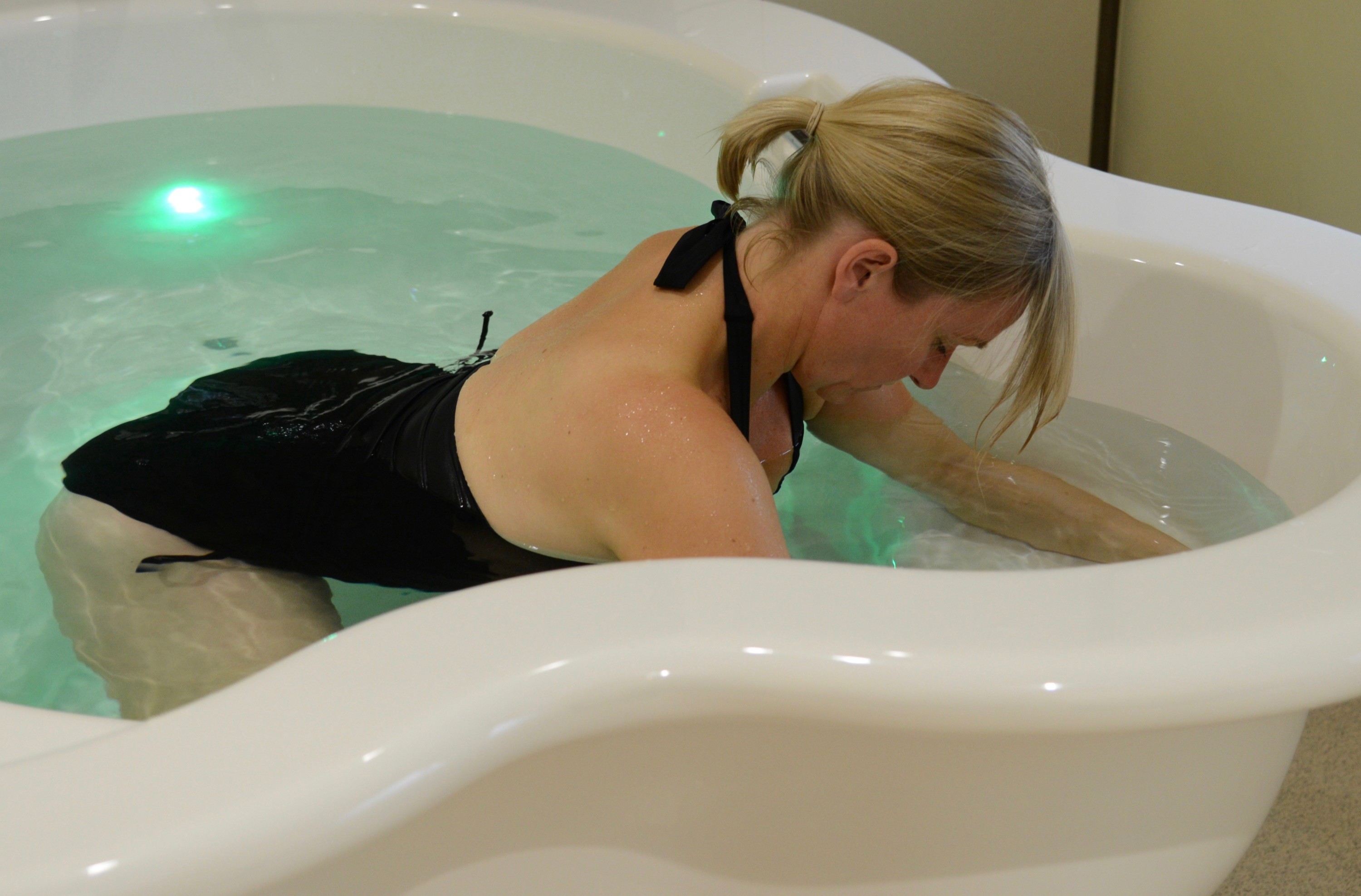
Why sit and swivel is especially important
Climbing a conventional step unit requires the mother to raise her centre of gravity, transfer her weight from one leg to the other and negotiate the pool wall while turning or stepping down. During labour, these movements may be made while she is tired, wet, contracting or unable to see her feet clearly.
For a larger mother, the demand on the knees, hips, pelvis and supporting leg can be greater, while the consequences of losing balance may affect both her and the staff member trying to steady her.
The Active Birth Pools sit-and-swivel method replaces climbing with a controlled sequence. The mother approaches the pool, uses the low single step where required, sits securely on the extra-wide rim, turns her body while seated, brings her legs into the pool and lowers herself into the water using the rim, recessed handrails and assistance appropriate to her assessed needs.[19,20]
Sitting before turning is the crucial ergonomic difference. Her weight is supported before she crosses the pool wall. She is not required to balance on one leg, step over a high edge or place her body weight through a midwife’s neck, shoulders or arms. The broad rim also gives her time to pause between contractions and complete each part of the movement in a controlled way.
For larger and less-mobile mothers, sit and swivel can:
- reduce the need to climb while wet, tired or contracting;
- avoid a high single-leg step over the pool wall;
- lower the mother’s centre of gravity before she turns;
- allow movement to be divided into small, controlled stages;
- provide a stable seated pause if a contraction begins;
- reduce the likelihood that the mother will pull heavily on a midwife for support;
- allow assistance to be planned around the individual rather than improvised;
- support dignity by enabling the mother to do as much of the movement as she can herself.
This is particularly important because HSE identifies active support during entry and exit, the mother’s position and the working posture of staff as sources of manual-handling risk around birthing pools.[12,20] A pool should therefore be judged not only by how comfortable it is once the mother is immersed, but by how safely and naturally she can cross its boundary.
Emergency evacuation must be anticipated in the pool design
Emergency evacuation from a birth pool is uncommon, but it must be treated as a foreseeable clinical and manual-handling task. NHS water-birth guidance commonly requires staff to know and rehearse the local evacuation procedure, and some policies specify staffing arrangements, evacuation equipment or drills.[21-23]
The safest response is not created at the moment an emergency occurs. It is created earlier through pool selection, room planning, equipment compatibility, staffing, training and rehearsal. A design that gives several practical evacuation options is safer than one that leaves the team dependent on a single difficult manoeuvre.
Active Birth Pools are designed around this reality. Their broad rim, rim-level safety seat, recessed handrails, open internal space and accessible pool perimeter can support a staged evacuation and give staff practical choices according to the mother’s condition.[20,24] The pool can also accommodate an appropriate portable hoist where the organisation’s risk assessment and procedure require one.[24]
Design features that support emergency evacuation include:
- a rim-level safety seat that provides an intermediate supported position close to the top of the pool;
- a broad, strong rim that can be approached from outside and used during a controlled transfer;
- recessed handrails and support points that do not obstruct the mother or evacuation equipment;
- generous internal space so staff can reposition the mother and place a sling or evacuation aid;
- an uncluttered water space without protruding fittings that impede movement;
- external access for staff, a bed or trolley and, where specified, a portable hoist;
- a pool and room layout that allows the agreed transfer route to be practised rather than assumed.
These features are especially significant for a larger mother because an improvised manual lift carries greater potential risk to her and to staff. However, emergency-friendly design is safer for everyone. A woman of any size may become faint, exhausted, unresponsive or suddenly unable to assist. The relevant safety question is not whether staff believe they could lift a particular mother; it is whether the complete system allows the team to evacuate any mother using a planned, practised and risk-assessed method.

Better for larger women – beneficial for every woman
The design features that can make water especially valuable for larger or less-mobile women also benefit women of every shape, size and level of mobility.
A woman who is highly mobile on land can use the pool to move even more fluidly between positions. She can kneel, squat, lunge, lean forward, rotate her pelvis or float during periods of rest. The resistance of the water allows movements to be slower and more controlled, while buoyancy reduces the muscular effort required to sustain them.
A woman of average size may find that a posture she could hold for only a few minutes on land can be maintained comfortably for much longer in water.
A tired woman may rediscover movement after entering the pool. A woman experiencing pelvic discomfort may find that water allows her to open or reposition her legs more comfortably. A woman who feels vulnerable or observed may experience the pool as a private, protected space.
Inclusive design does not provide a special facility for one category of woman at the expense of another. It creates a better environment for everyone.
When a pool is deep enough for a large woman, it provides effective immersion for a smaller woman. When it is spacious enough for a woman with restricted movement to turn comfortably, it gives a more mobile woman freedom to explore a wider range of positions. When the supports are strong and well positioned, every mother can use them instinctively.
The pool itself makes a difference
Simply offering “access to water” is not enough. The design of the pool determines whether that access is meaningful.
An appropriate water birth pool should provide:
- sufficient depth for effective buoyancy;
- enough internal space for unrestricted movement;
- stable support for upright and forward-leaning postures;
- comfortable places to rest while remaining immersed;
- secure and dignified entry and exit;
- surfaces that support traction;
- good access for midwives;
- compatibility with local emergency and manual-handling procedures.
From a health-and-safety perspective, generous working space, unobstructed internal contours, accessible support points and a controlled sit-and-swivel entry method are not merely comfort features. They are ergonomic features that can reduce avoidable physical demands on the mother and the staff caring for her. Local risk assessment must still consider the complete installation, staffing model, evacuation plan and any auxiliary equipment.
Active Birth Pools have been developed specifically around these requirements. They are hospital sanitary products designed for professional maternity environments – not medical devices and not enlarged domestic baths.
Their purpose is to give mothers the space, depth, comfort and support required to remain active in water, while enabling midwives to observe and care for them effectively.

A more inclusive approach to water birth
Larger and plus-size women should not be made to feel that physiological labour, active birth or water immersion belong only to smaller, highly mobile bodies.
For some women, the benefits of water are pleasant and comforting.
For others, buoyancy may be the factor that makes upright movement, pelvic mobility and positional choice physically possible.
Maternity services should recognise this distinction. Instead of asking whether a larger woman fits a conventional model of water-birth eligibility, they should consider whether the right pool, room, assessment and support plan can meet her individual needs.
A well-designed Active Birth Pool gives larger and less-mobile mothers a better opportunity to experience comfort, autonomy, freedom of movement and the postures that may support physiological labour.

References
- Aughey, H. et al. (2021). Waterbirth: a national retrospective cohort study of factors associated with its use among women in England. BMC Pregnancy and Childbirth, 21, 256.
- World Health Organization (2018). WHO recommendations: Intrapartum care for a positive childbirth experience. Recommendation 25: maternal mobility and position.
- National Institute for Health and Care Excellence (2025). Intrapartum care, NICE guideline NG235. Recommendations 1.6.13 and 1.9.5-1.9.6.
- Burns, E. et al. (2022). Systematic review and meta-analysis to examine intrapartum interventions and maternal and neonatal outcomes following immersion in water during labour and waterbirth. BMJ Open, 12, e056517.
- Mellado-García, E. et al. (2024). Water immersion during labour and birth: systematic reviews and synthesis without meta-analysis. Healthcare, 12.
- Active Birth Pools. Active II/360 Birth Pool: Technical Specifications. Water depth approximately 640 mm at the stated filling level.
- Active Birth Pools. Venus II and Venus 360 Birth Pools: Technical Specifications. Water depth approximately 640-650 mm at the stated filling level.
- Royal College of Obstetricians and Gynaecologists (2018). Care of Women with Obesity in Pregnancy, Green-top Guideline No. 72.
- Active Birth Pools. Material Specification: Ficore®. Comparative material characteristics, including traction and performance relative to acrylic and fibreglass.
- Great Britain (1992). Manual Handling Operations Regulations 1992, SI 1992/2793, regulation 4 and Schedule 1.
- Health and Safety Executive (2025). Manual Handling Operations Regulations 1992: Guidance on Regulations, L23. Guidance on avoiding, assessing and reducing manual-handling risk.
- Health and Safety Executive (2026). Moving and handling in health and social care. Guidance on preventing injury to people receiving care and to workers.
- Chartered Institute of Ergonomics & Human Factors. Healthcare Sector and What is Ergonomics? Guidance on designing healthcare systems around human capabilities, safety and wellbeing.
- Health and Safety Executive (2025). Assess manual handling you cannot avoid. Guidance on task, load/person, working environment and individual capability, including awkward postures, reaching and twisting.
- Health and Safety Executive (2026). Getting help with manual handling risks in your business. Guidance noting that general lifting-technique training alone is not an effective substitute for changing work and controlling risk.
- Great Britain (1998). Lifting Operations and Lifting Equipment Regulations 1998, SI 1998/2307.
- Health and Safety Executive (2026). Moving and handling equipment in health and social care. Guidance on selection, use, inspection and examination of equipment used to move or lift people.
- Health and Safety Executive (2025). Safe use of lifting equipment: Lifting Operations and Lifting Equipment Regulations 1998. Approved Code of Practice and guidance, L113.