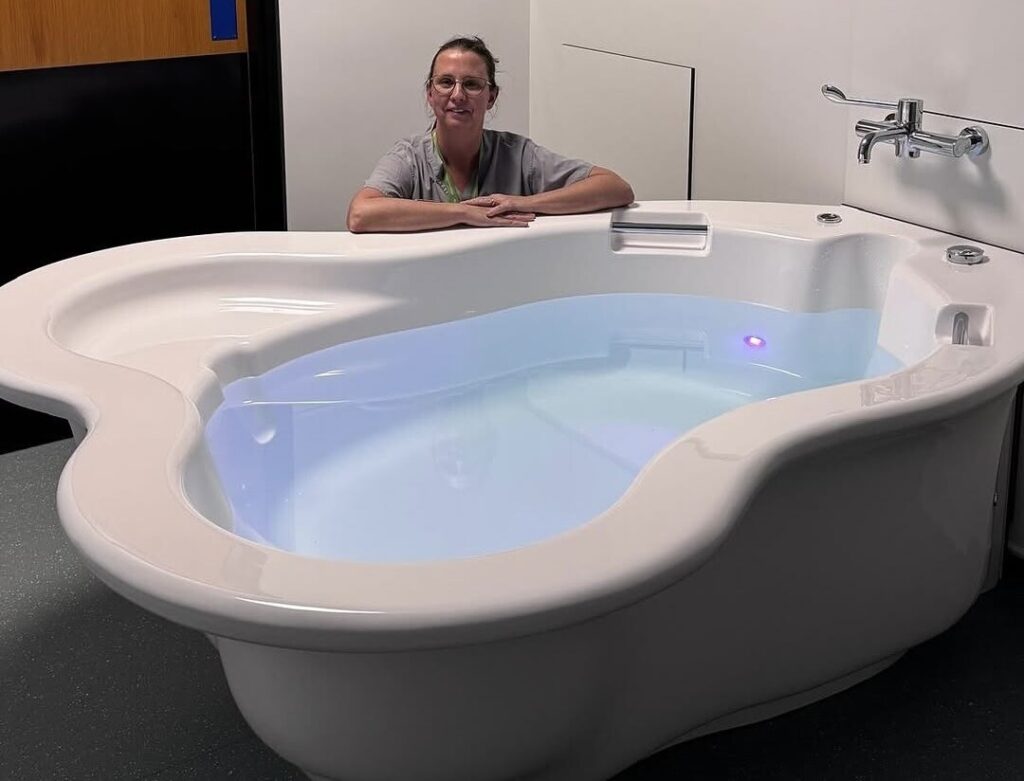

Why water birth pools are a practical investment in safer, more efficient maternity care
Maternity services are under pressure to provide safer, more personalised care while making the best possible use of staff, space and budgets. In this environment, a well-designed water birth pool should not be viewed simply as an additional facility or optional extra. It should be understood as a practical investment in the quality, efficiency and resilience of maternity care.
In England, NHS hospital maternity activity remains substantial: the latest NHS maternity statistics reported 542,235 deliveries during 2024-25, with 45% of deliveries by caesarean section. At the same time, NHS England has highlighted major pressures on maternity and neonatal infrastructure, including limited space, equipment and privacy, staff wellbeing issues and a large national estate maintenance backlog.1,2
Water immersion supports physiological labour by helping mothers relax, move more freely and cope better with contractions. For many women, labouring in warm water reduces fear, increases confidence and creates a calmer birth environment. When a pool is available, suitable mothers are more likely to remain mobile, upright and actively engaged in the birth process.
The economic value of water birth pools is therefore not limited to the purchase price of the pool. The real value lies in their ability to support lower-intervention care, reduce pressure on clinical resources, improve the birth environment, protect midwives from unnecessary strain and provide a durable asset that serves the hospital for many years.
Maternity services need facilities that support efficient care
Hospitals and maternity units are being asked to deliver high-quality care in increasingly complex circumstances. Caesarean birth, induction, intervention and neonatal admission all have important clinical roles, but they also increase demand on theatres, anaesthetic teams, postnatal beds, neonatal services and midwifery time.
For women with uncomplicated pregnancies, water immersion offers a low-technology, non-pharmacological form of pain relief that can help preserve normal labour. NICE recommends offering women the opportunity to labour in water for pain relief. It also states that, when women labour in water, the temperature of the woman and the water should be monitored hourly and that the water temperature should not exceed 37.5°C.3,4
A birth pool does not replace clinical judgement, skilled midwifery care or obstetric support when needed. Instead, it gives maternity teams a practical facility that helps suitable women labour in a way that is comfortable, supported and consistent with physiological birth.
The more effectively a maternity unit can support straightforward labour for women who are clinically suitable, the more capacity it preserves for women and babies who genuinely need higher levels of care.
Reduced reliance on pharmacological pain relief
One of the clearest economic arguments for water immersion is its effect on pain management. Warm water can reduce the need for pharmacological analgesia for some women, particularly epidural analgesia. The 2018 Cochrane review concluded that water immersion during the first stage of labour probably results in fewer women having an epidural and found no evidence that labouring in water increases adverse outcomes for women or newborns, although the certainty of evidence varies across outcomes.5
Epidurals are an important and valuable option, but they require additional clinical input, monitoring, equipment and, in many cases, reduced mobility. Regional analgesia is associated with a more intensive level of observation and can affect the flow of care within the labour ward.
Water immersion provides a simple, continuous form of comfort and support. Once the pool is filled and the woman is safely assessed as suitable, the pool becomes part of the care environment. It can help mothers manage pain while remaining mobile and responsive to their bodies. This can reduce dependency on more resource-intensive forms of pain relief for women who do not need or do not want them.
For hospitals, even a modest reduction in the use of higher-cost interventions across hundreds or thousands of births can have a meaningful cumulative effect.
Supporting physiological birth and reducing avoidable intervention
A water birth pool is not just a container of warm water. When properly designed, it becomes an active birth environment.
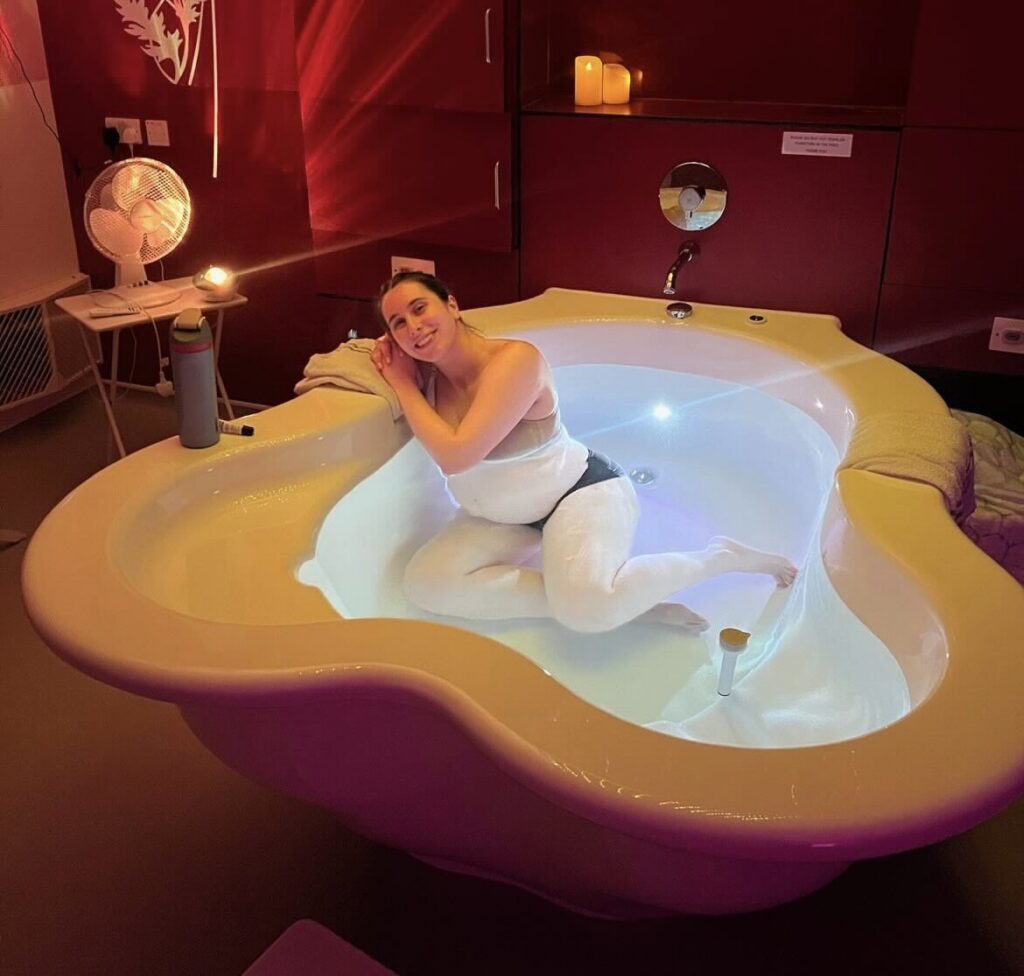
The buoyancy of water allows mothers to change position more easily. Upright, forward-leaning and kneeling positions can be adopted with less strain. Mothers can rest between contractions, rotate their pelvis, lean, squat or float according to instinct and comfort. This freedom of movement can support the progress of labour and help mothers feel more in control.
NICE now advises clinicians to consider birth in water and to support informed choice by discussing the available evidence, including potential reductions in severe perineal trauma for multiparous women, lower postpartum haemorrhage risk, lower neonatal unit admission risk, an increased risk of snapping of the cord before clamping, and inconclusive evidence on perinatal mortality differences.6
The POOL cohort study, which examined 73,229 low-risk women using water immersion in labour across 26 UK NHS maternity services, found that waterbirth was not associated with higher risk of the study’s primary adverse maternal or neonatal outcomes compared with leaving the water before birth.7
A well-designed pool also changes the atmosphere of the room. It reduces the dominance of the bed and helps create an environment in which the mother is not positioned as a passive patient. This matters because the physical environment influences behaviour. When the room encourages movement, privacy, calm and confidence, it becomes easier to support physiological labour.
The economic implications are clear. Care that helps suitable women avoid unnecessary escalation can reduce the need for additional procedures, reduce pressure on staff and improve throughput within maternity services.
Better use of rooms, staff and clinical resources
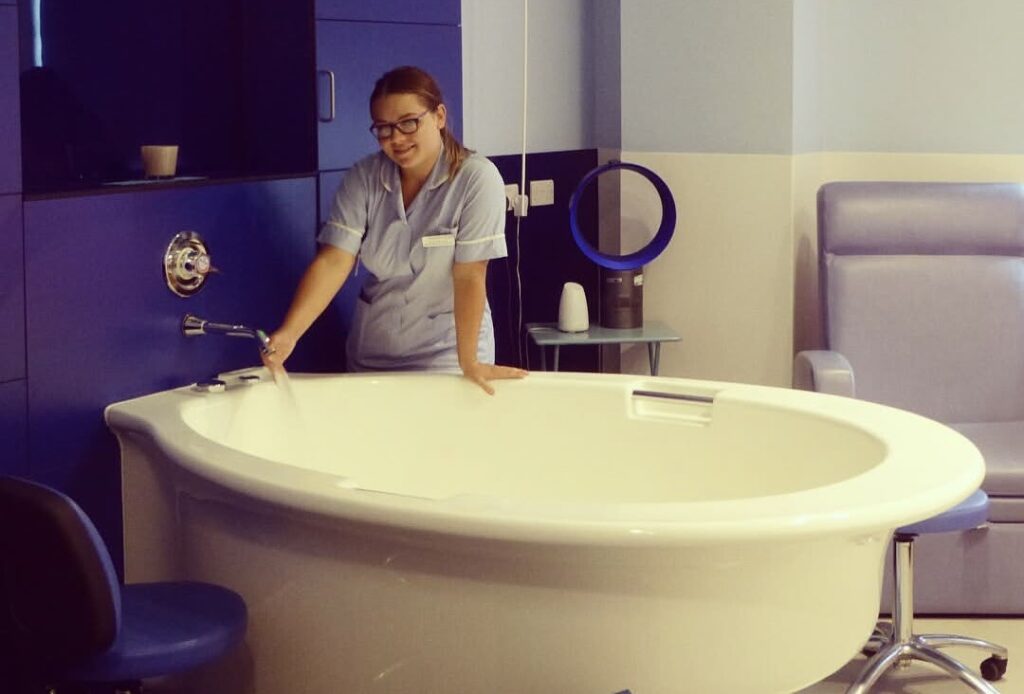
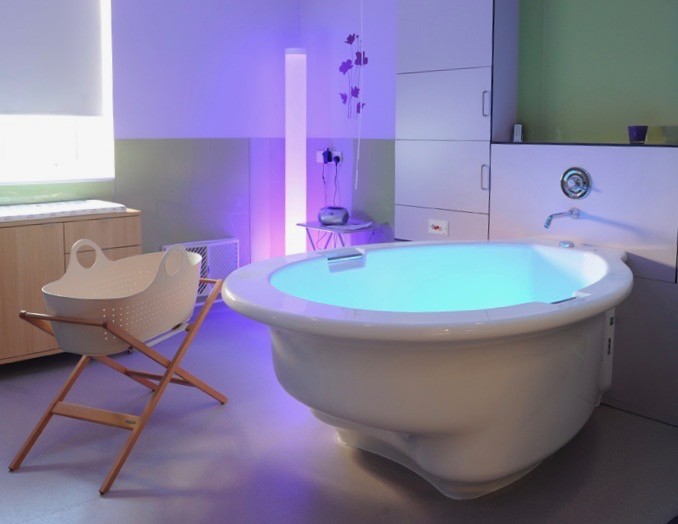
Birth pools can improve the functionality of maternity rooms when they are integrated correctly. A pool that is easy to access, easy to clean and ergonomically designed can become a core part of the room rather than an occasional facility.
For midwives, the design of the pool has a direct effect on working conditions. Poorly designed pools can require awkward bending, overreaching, kneeling or physical support of the mother during entry and exit. Over time, these risks contribute to fatigue and musculoskeletal strain.
Active Birth Pools are designed to reduce these risks. Features such as wide rounded rims, integrated handholds, recessed surrounds, safe entry and exit, and uncluttered interiors support safer working postures and better access for care. Active Birth Pools’ own ergonomics guidance emphasises maternal freedom of movement, adequate space and depth, integrated support and protection of midwives from awkward working postures.8
Reducing manual handling risk is not only a health and safety matter. It has economic consequences. Staff injury, sickness absence, fatigue and reduced job satisfaction all carry costs. Equipment that helps midwives work safely and comfortably contributes to workforce sustainability.
Infection control and cleaning efficiency
In a busy maternity unit, a birth pool must be easy to clean thoroughly and consistently between uses. Infection control is therefore central to economic performance. NICE says baths and birthing pools should be kept clean using a protocol agreed with the local microbiology department or infection-control guidance and, for birthing pools, in accordance with the manufacturer’s guidance.9
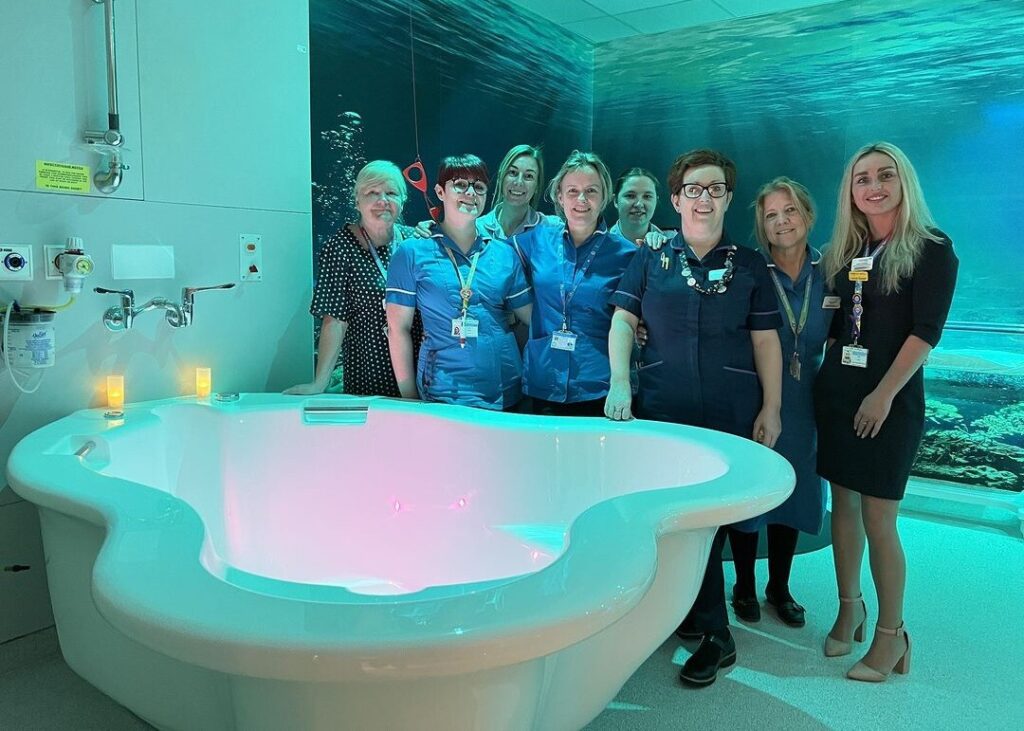
Active Birth Pools are made from Ficore® composite and have seamless, one-piece construction. The smooth, non-porous surface and absence of unnecessary surface-mounted fittings help remove dirt traps and reduce cleaning challenges. Active Birth Pools’ cleaning guidance states that Ficore is highly resistant to disinfection, and that seamless one-piece construction and the absence of surface-mounted metalwork help deny micro-organisms the environment they need to propagate.10
This has practical benefits for hospitals. A pool that is simpler to clean can be returned to use more efficiently. It also supports compliance with local cleaning protocols, infection-control guidance and manufacturer instructions.
Cleaning time, staff time, room turnover, water safety and confidence in hygiene all affect the operational value of a birth pool. A lower-cost pool that is difficult to clean, vulnerable to surface damage or dependent on awkward fittings can become more expensive over its lifetime.
Durability, lifespan and whole-life value
The purchase price of a birth pool is only one part of the financial calculation. Hospitals should consider the full life-cycle cost: installation, maintenance, cleaning, repair, downtime, replacement and disposal.
Active Birth Pools are engineered for long-term hospital use. Ficore® composite is strong, durable, warm to the touch and resistant to damage. Active Birth Pools state that their pools are engineered to last for more than 25 years in demanding clinical environments with minimal maintenance, and that long lifespan helps reduce waste, downtime and replacement costs.11
This long lifespan changes the economics. A pool that performs reliably for decades can deliver far greater value than a cheaper product that requires regular repair, creates downtime or needs replacing after a shorter period.
Durability also supports sustainability. Long-life sanitary ware reduces waste, avoids repeated procurement cycles and helps hospitals make responsible infrastructure decisions.
The value of better birth experiences
The economic case for water birth pools is not only about direct cost avoidance. It is also about quality of care.
Women who feel calm, respected, mobile and supported during labour are more likely to describe their birth positively. A positive birth experience can influence confidence, bonding, breastfeeding and emotional recovery. For families, this matters profoundly. For hospitals, it contributes to reputation, service quality, patient satisfaction and community trust.
Maternity units are increasingly judged not only by clinical outcomes but by how women and families experience care. A high-quality water birth facility sends a clear message: the service values choice, dignity, comfort and evidence-based physiological birth.
A practical return on investment
The return on investment from a hospital-grade water birth pool can be seen in several areas:
- reduced reliance on pharmacological pain relief for suitable women
- better support for physiological labour
- improved use of maternity rooms
- shorter cleaning and turnaround processes when the pool is designed for infection control
- reduced manual handling risk for midwives
- fewer maintenance and replacement costs over time
- improved maternal satisfaction and service reputation
- a more attractive, calming and functional birth environment
These benefits accumulate over years of use. In a unit with regular demand for water immersion, a high-quality pool can quickly become one of the most cost-effective elements of the maternity environment.
Why design quality matters
Not all birth pools deliver the same economic value. A poorly designed pool can create hidden costs: difficult cleaning, awkward access, staff strain, maintenance issues, safety concerns, poor heat retention, water-management problems and shorter service life.
When assessing a birth pool, decision-makers should look beyond appearance and initial price. The key questions are:
- Is the pool easy to clean and disinfect?
- Does it avoid unnecessary surface-mounted fittings?
- Does it support safe entry and exit?
- Does it protect midwives from awkward working postures?
- Does it allow mothers to move freely?
- Is it made from a durable, repairable, hospital-suitable material?
- Will it perform reliably for decades?
- Does the manufacturer understand maternity care, infection control, manual handling and healthcare estates requirements?
Active Birth Pools are designed around these priorities. They are not adapted domestic baths. They are purpose-designed, hospital-grade sanitary ware products for maternity environments.
Water birth pools offer hospitals a rare combination of clinical, operational and economic value.
They support women to labour with greater comfort, mobility and confidence. They help midwives provide safer, more ergonomic care. They create calmer, more attractive maternity environments. They can reduce reliance on more resource-intensive forms of pain relief and support lower-intervention care for suitable women. When designed and manufactured to a high standard, they also provide exceptional long-term value.
For hospitals, the question should not be whether a water birth pool is an added cost. The better question is what value a well-designed pool can deliver over many years of daily clinical use.
A high-quality Active Birth Pool is an investment in safer care, better experiences, improved efficiency and long-term performance.
References
- NHS England Digital, NHS Maternity Statistics, 2024-25, published 16 December 2025 and last edited 4 March 2026. The key facts report 542,235 deliveries during 2024-25 and 45% of deliveries by caesarean section. URL: https://digital.nhs.uk/data-and-information/publications/statistical/nhs-maternity-statistics/2024-25
- NHS England, Maternity and neonatal infrastructure review findings, 11 September 2025. The review reports that overall spend on NHS maternity services was around £4 billion in 2021/22 and highlights major estate pressures, including space, privacy, storage, staff wellbeing and infrastructure quality. URL: https://www.england.nhs.uk/long-read/maternity-and-neonatal-infrastructure-review-findings/
- NICE, Intrapartum care NG235, recommendation 1.6.10: ‘Offer the woman the opportunity to labour in water for pain relief.’ URL: https://www.nice.org.uk/guidance/ng235/chapter/Recommendations
- NICE, Intrapartum care NG235, recommendations 1.6.11 and 1.6.12: monitor water and maternal temperature hourly, keep water no higher than 37.5°C, and clean baths and birthing pools using local microbiology/infection-control protocols and manufacturer’s guidance. URL: https://www.nice.org.uk/guidance/ng235/chapter/Recommendations
- Cluett ER, Burns E, Cuthbert A. Immersion in water during labour and birth. Cochrane Database of Systematic Reviews. 2018;5:CD000111. The review found that first-stage water immersion probably reduces epidural use and found no evidence of increased adverse outcomes for women or newborns, while noting variable evidence certainty. URL: https://www.cochranelibrary.com/cdsr/doi/10.1002/14651858.CD000111.pub4/full
- NICE, Intrapartum care NG235, recommendation 1.9.24. NICE advises considering birth in water and discussing the evidence on severe perineal trauma, postpartum haemorrhage, cord snapping before clamping, neonatal unit admission and inconclusive evidence on perinatal mortality differences. URL: https://www.nice.org.uk/guidance/ng235/chapter/Recommendations
- Sanders J, et al. Maternal and neonatal outcomes among spontaneous vaginal births occurring in or out of water following intrapartum water immersion: The POOL cohort study. BJOG. 2024. The study included 73,229 women without antenatal or intrapartum risk factors across 26 UK NHS maternity services and found waterbirth was not associated with higher risk of its primary adverse maternal or neonatal outcomes. URL: https://obgyn.onlinelibrary.wiley.com/doi/10.1111/1471-0528.17878
- Active Birth Pools, The Importance of Applying Ergonomic Design Principles to Water Birth Pools, 11 June 2025. The article emphasises maternal freedom of movement, integrated support, space and depth for immersion, and reducing awkward postures for midwives. URL: https://activebirthpools.com/the-importance-of-applying-ergonomic-design-principles-to-water-birth-pools/
- NICE, Intrapartum care NG235, recommendation 1.6.12: birthing pools should be cleaned using local microbiology/infection-control protocols and manufacturer’s guidance. URL: https://www.nice.org.uk/guidance/ng235/chapter/Recommendations
- Active Birth Pools, Cleaning and Care, 5 December 2020. The page states that Ficore is highly resistant to disinfection, and that seamless one-piece construction and the absence of surface-mounted metalwork help deny micro-organisms the environment they need to propagate. URL: https://activebirthpools.com/cleaning-care/
- Active Birth Pools, Why Choose a Water Birth Pool from Active Birth Pools?, 6 December 2025. The page states that Active Birth Pools are made from Ficore® composite and engineered to last for more than 25 years in demanding clinical environments with minimal maintenance. URL: https://activebirthpools.com/why-choose-a-water-birth-pool-from-active-birth-pools/
Additional background sources
- Burns E, et al. Systematic review and meta-analysis to examine intrapartum interventions, and maternal and neonatal outcomes following immersion in water during labour and waterbirth. BMJ Open. 2022;12:e056517. URL: https://bmjopen.bmj.com/content/12/7/e056517
- Active Birth Pools, The Economic Impact of Water Birth Pools in Hospitals. Original article, 28 August 2019. URL: https://activebirthpools.com/the-economic-impact-of-water-birth-pools-in-hospitals/